
Vantaanjoki River
About the supersite
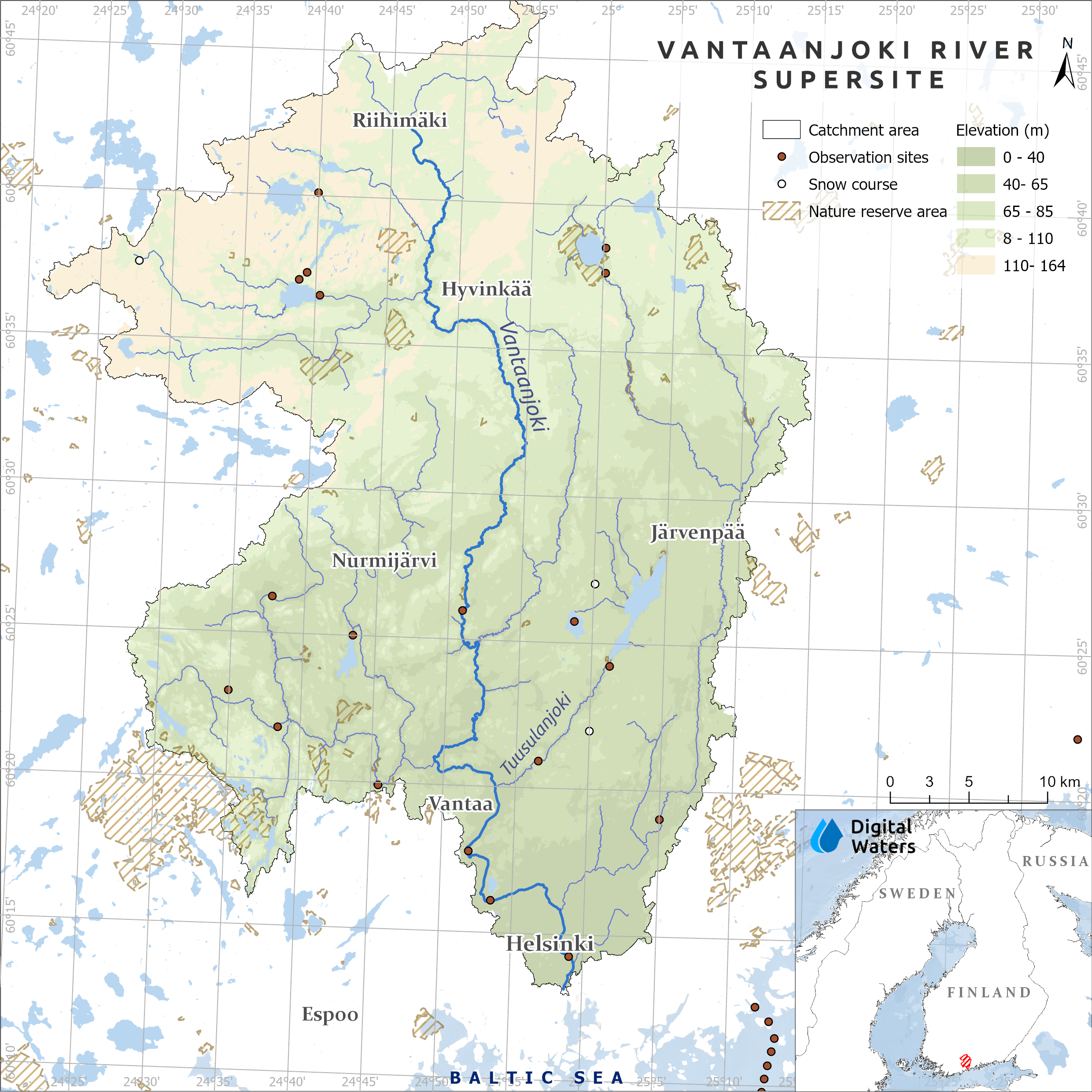
The Vantaanjoki catchment extends from rural and agricultural headwaters through the Helsinki metropolitan area to the Gulf of Finland. The supersite includes intensive monitoring stations at Pitkäkoski, Ylikylä and Myllymäki, as well as the agricultural Lepsämänjoki sub-catchment. These sites complement Finland’s long-term national hydrological monitoring network and support modelling and forecasting efforts.
The site also covers Vanhankaupunginlahti Bay and the coastal waters of the Gulf of Finland, where the impacts of riverine inputs on coastal water quality are studied from the river mouth to the open sea using in situ measurements and Earth observation data.
The Vantaanjoki River supersite brings together long-term environmental monitoring, high-frequency sensor measurements, groundwater observations, and modelling to provide an integrated view of catchment processes.
The site supports research on river flow, floods, droughts, water quality and material loads, while improving understanding of groundwater dynamics and availability. It also enables studies on the connections between land use, catchment conditions, river transport, and coastal water quality. By combining observations and modelling across the land-water-sea continuum, the supersite supports the development of digital solutions for water management, risk assessment, and climate adaptation.
Whole catchment
The entire Vantaanjoki catchment is represented through integrated hydrological and water-quality modelling, supported by observations from monitoring sites across the basin. These models help predict river flow, floods, droughts, and nutrient transport, while supporting water management, assessment of pollution sources, and climate-change impacts.
River mouth and coastal waters
Vanhankaupunginlahti Bay and the adjacent Gulf of Finland form the coastal component of the supersite. Observations and model results from the Vantaanjoki catchment are combined with coastal water-quality measurements and Earth observation data to investigate how river-borne materials and catchment pressures affect coastal waters from the river mouth to the open sea.
Pitkäkoski
Pitkäkoski is a key monitoring site in the Vantaanjoki catchment, providing continuous observations of water quality and water level. Regular water sampling complements the high-frequency sensor measurements. Seasonal surveys of river discharge, channel morphology and surrounding environmental conditions, including UAV-based remote sensing, provide additional data for hydrological and water-quality modelling. Together, these observations improve understanding of catchment processes and water-quality dynamics.
Lepsämänjoki
Lepsämänjoki is an intensively monitored agricultural sub-catchment of the Vantaanjoki River basin. Long-term high-frequency observations of water quality, water level, and discharge are complemented by regular water sampling. The site supports research on runoff processes, nutrients, carbon and suspended-solid loads, diffuse agricultural pollution, and the effectiveness of water-protection measures. The monitoring infrastructure includes continuous in situ measurements, data services, and hydrological and water-quality modelling.
Ylikylä
A 200 meter reach of the river at Ylikylä is monitored seasonally using river-discharge surveys and UAV-based remote sensing. Continuous RGB and thermal camera observations complement the field measurements, providing detailed information on river conditions and environmental change.
Myllymäki
A 600 meter reach of the river at Myllymäki is monitored seasonally to study river flow and channel morphology. Riverbank sensors provide additional information on soil moisture and temperature conditions, supporting research on river and catchment processes.
Data and observations
Open data, in situ sensor networks, high-frequency monitoring, field measurements, water-quality sampling, remote sensing, bathymetric surveys, and topographic mapping.
Environmental processes
Catchment hydrology, runoff generation, river dynamics, pollutant transport, land-use change, and the impacts of climate variability on floods and droughts.
Water quality and material fluxes
Nutrients, suspended solids, organic carbon, stormwater pollutants, emerging contaminants, PFAS, and the processes controlling their movement through the environment, loading from agriculture.
Modelling and forecasting
Hydrological, water-quality, hydrodynamic, nutrient-load, stormwater, and contaminant-transport modelling to support analysis and prediction.
Management and decision support
Science-based tools for reducing nutrient loading, managing stormwater, adapting to flood risks, restoring aquatic ecosystems, tracking pollution sources, and building climate-resilient catchments.
- The Vantaanjoki River Supersite includes several observation sites monitoring hydrological conditions and water quality, with 19 comprising the main part of the Supersite.
- Hydrological monitoring: Measurements of river discharge and water levels.
- Water-quality monitoring: Measurements of temperature, pH, electrical conductivity, dissolved oxygen, turbidity, suspended solids, nutrients and organic matter.
- Additional sampling: Selected sampling programmes assess chlorophyll-a, fecal indicator of bacteria and contaminants, including PFAS and metals.
Understanding how hydrology, climate change, agricultural practices and water management affect rivers and the sea to support efficient, climate-resilient river basin management.
- High nutrient loads, turbidity, and diffuse pollution from agriculture and urban areas continue to degrade water quality and ecological status
- PFAS contamination: PFOS concentrations in perch at Tikkurilankoski exceeded the environmental quality standard, highlighting PFAS contamination as a serious challenge in the catchment.
VHVSY
- At Vantaanjoki the ongoing cooperation with VHVSY aims to promote catchment-based water resources management and water management in the Vantaa River area by combining practical water protection work, research knowledge, and digital solutions. Read more about Vesistöhanke.