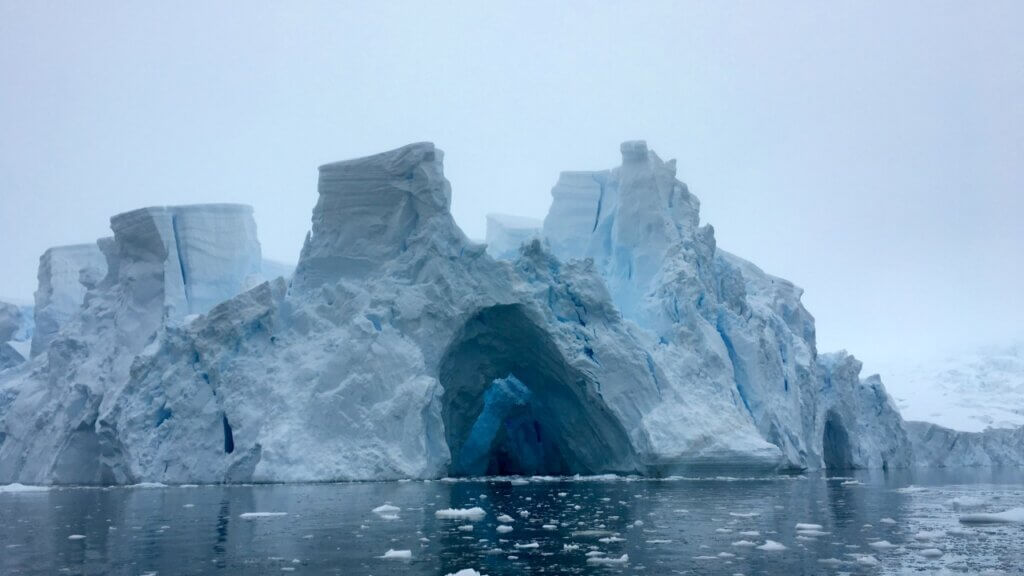
“Glaciers are melting faster than ever. As the planet gets hotter, our frozen world is shrinking, making the water cycle more unpredictable.” The research in Digital Waters Flagship has a strong focus on the boreal zone. Environmental change regarding ice-covered rivers and snow-cover impacts on hydrology are themes that our researchers have very strong competence in regarding the Boreal region.
Some of our staff also regularly visit the high latitudes of the world, and in the World Water Day seminar 2025 organized by DIWA and Water Association Finland, we get to hear stories from far South, all the way from Antarctica. One of DIWA’s research professors, Dr Antero Kukko from the Finnish Geospatial Research Institute FGI spent the winter with the FINNARP expedition 2023-2024 at the Aboa research station, located on Basin Nunatak at Vestfjella mountains (73⁰03’S, 13⁰25’W), Dronning Maud Land.
No matter how isolated, cold, and at times inhospitable, Antarctica tends to get a hold of the people who get to visit the continent and never let go – Antero is heading back to Dronning Maud Land possibly already next winter. In the previous expedition, the focus was on measuring the surface structure of the snow and ice fields and detecting its impact on the Albedo effect and climate models. This time the expedition will focus on a rare positive example of the Southern continent ice. “The Queen Maud land has an ice sheet at the margins of Antarctica, that, unlike the surrounding examples, is not shrinking but growing in mass. Our goal is to find out what is the reason for this area standing out. Finding out what causes this anomaly, can help us understand the future of glacier ice better.” Antero explains.
The work is carried out by laser scanning, satellite observations, and ice mass modeling, to make predictions for the future of the whole ice sheet, in collaboration with the Finnish Meteorological Institute with the joint project EXQALIBR.
Join us in March to hear more about Antero’s research, as well as many other interesting presentations regarding for example glaciers, sea- and river ice!
The two icy sessions and the discussion panel in the seminar are moderated by our DIWA scientist Maria Kämäri and carried out by laser scanning, satellite observations, and ice mass modeling, to make predictions for the future of the whole ice sheet, in collaboration with the Finnish Meteorological Institute with the joint project EXQALIBR.
Join us in March to hear more about Antero’s research, as well as many other interesting presentations regarding for example glaciers, sea- and river ice!
The two icy sessions and the discussion panel in the seminar are moderated by our DIWA scientists Maria Kämäri from Finnish Environment Institute SYKE, Eliisa Lotsari from Aalto University, and Pertti Ala-Aho from the University of Oulu.
See the program and register for the event in person or online: https://www.vesiyhdistys.fi/2025/02/04/maailman-vesipaivan-seminaari-2025-glacier-preservation-jaatikoiden-suojelu-in-wider-context-including-seasonal-ice-on-land-fresh-waters-and-seas/