Mehran Mahdian, University of Eastern Finland, mehran.mahdian@uef.fi
Finland is often called the “land of a thousand lakes” – in reality, it has nearly 188,000 lakes. Many of them lie in remote northern regions where they quietly support wildlife, fisheries, and provide clean drinking water for local communities. But despite their importance, understanding what happens inside these lakes is not always easy.
Scientists regularly monitor lake water quality, but most measurements come from the surface layer, simply because it is easier and cheaper to collect samples there. Yet many of the most important ecological processes actually take place much deeper in the lake. In the hypolimnion, the cold and dark bottom layer of stratified lakes, oxygen can disappear, and nutrients can accumulate. These changes can strongly affect fish habitats, water quality, and the overall health of the ecosystem. The challenge is that measuring these deep-water conditions requires special equipment, field campaigns, and laboratory analyses, which are costly and particularly difficult in remote Arctic environments.
Can we predict deep-water conditions from surface measurements?
In my doctoral research at the University of Eastern Finland, I investigate whether modern machine learning can help fill this monitoring gap. Instead of directly measuring water quality deep in the lake, we ask whether it is possible to predict deep-water conditions using measurements already taken at the surface, such as:
- Water temperature
- Nutrient concentrations (Nitrogen and phosphorus)
- Dissolved oxygen
- Turbidity (water clarity)
- Conductivity
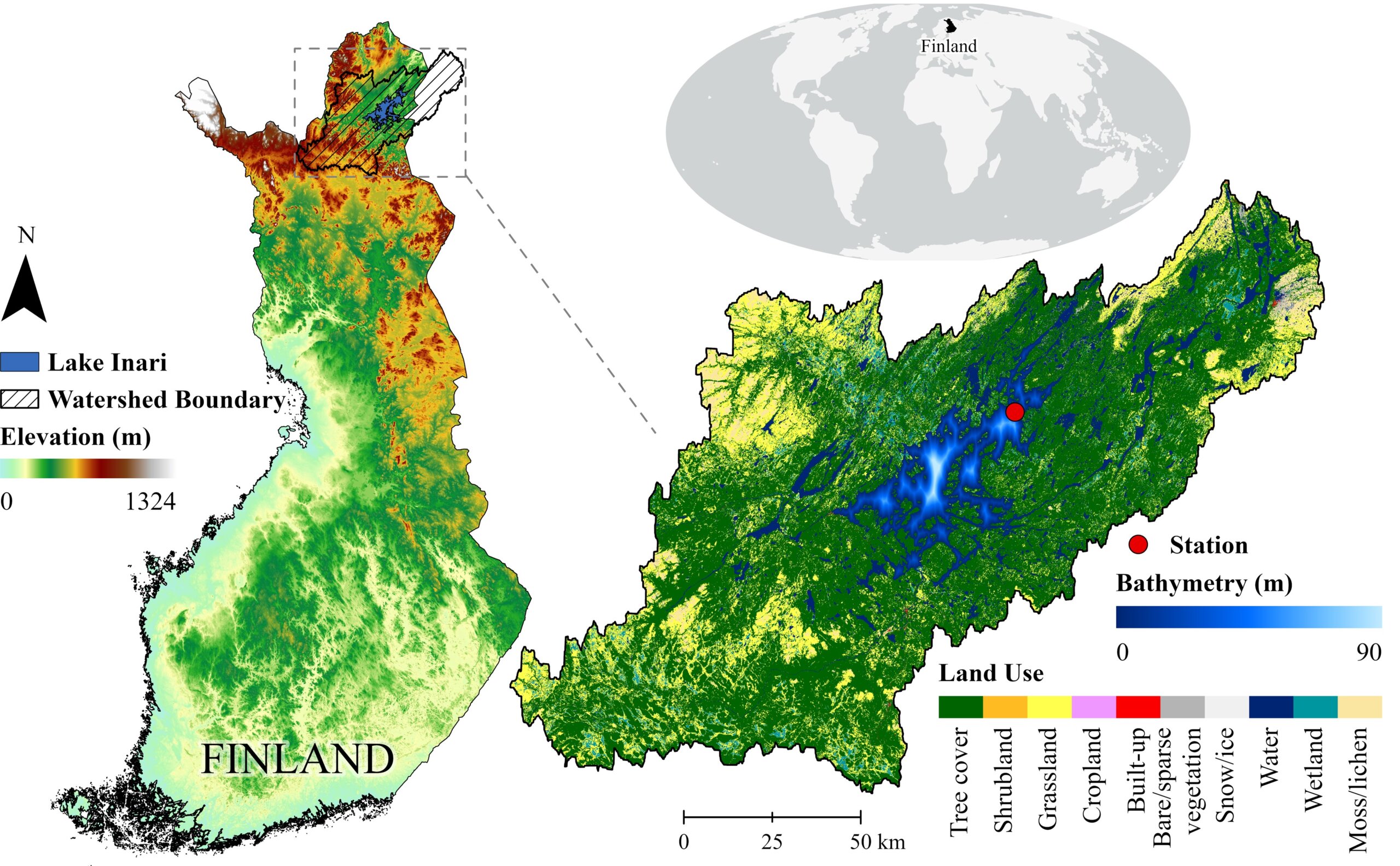
These variables are already monitored routinely in many lakes. Using more than 40 years of monitoring data from Lake Inari in northern Finland, we developed machine learning models that learn the relationships between surface conditions and what happens deeper in the lake. Lake Inari provides an ideal natural laboratory for this research. It is Finland’s third-largest lake and one of the largest lakes north of the Arctic Circle. The dataset used in this study spans 1979–2022 and includes measurements from both the surface and deep-water layers.
Teaching machines to understand lake ecosystems
To explore these relationships, we trained five different machine learning models, including:
- Artificial Neural Networks (ANN)
- Random Forest (RF)
- XGBoost
- Support Vector Regression (SVR)
- Kolmogorov-Arnold Networks (KAN)
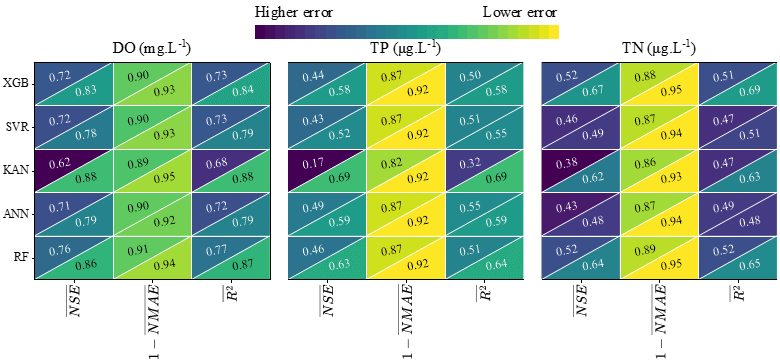
These models learn complex patterns from the data, helping them estimate conditions in the hypolimnion (deep water) based on measurements from the epilimnion (surface layer). The results were encouraging. Several models were able to accurately estimate deep-water water quality using only surface observations. For example:
- Random Forest models performed best at predicting deep-water dissolved oxygen and nitrogen levels.
- Artificial Neural Networks showed strong performance for predicting phosphorus concentrations.
Overall, the models reproduced deep-water oxygen conditions with high accuracy, suggesting that surface measurements contain more information about deeper lake layers than we might expect.
Why temperature matters
One of the most important insights from this research is the critical role of water temperature. During summer, lakes often become stratified, meaning warm water sits on top of colder water. These layering limits mix between the surface and the deeper parts of the lake. When this happens, deep water can become isolated from atmospheric oxygen, which affects both oxygen levels and nutrient cycling. Our analysis showed that surface temperature was one of the strongest predictors of deep-water conditions, especially dissolved oxygen. This finding is particularly important because climate change is altering lake temperatures and ice-cover duration in northern regions. As lakes warm and stratification patterns shift, deep-water ecosystems may experience significant changes.
Toward smarter lake monitoring
As environmental monitoring technologies continue to evolve, integrating machine learning, remote sensing, and sensor networks will play a key role in understanding freshwater ecosystems. In the future, similar models could be applied to many lakes across Finland and beyond, helping scientists and decision-makers monitor water quality more efficiently. By combining traditional field measurements with modern data science, we can move toward smarter, more adaptive lake management in a changing climate.
Traditional lake monitoring relies heavily on field sampling and laboratory analysis, which remain essential for understanding freshwater ecosystems. However, machine learning can act as a powerful complement to these methods. By combining long-term monitoring data with artificial intelligence, we can:
- Estimate deep-water conditions more frequently
- Reduce monitorin costs
- Detect ecological changes earlier
- Support better water management decisions
This approach is particularly valuable for remote Arctic lakes, where monitoring resources are limited, but environmental changes are occurring rapidly.
As environmental monitoring technologies continue to evolve, integrating machine learning, remote sensing, and sensor networks will become increasingly important for understanding freshwater ecosystems. In the future, similar models could be applied to many lakes across Finland and beyond, helping scientists and decision-makers monitor water quality more efficiently. By combining traditional field measurements with modern data science, we can move toward smarter, more adaptive lake management in a changing climate.
Reference(s)
- Mahdian, M., Noori, R., Saravani, M. J., Shahvaran, A. R., Shahmohammad, M., Gaffney, P. P. J., Salamattalab, M. M., Anboohi, M. S., Hosseinzadeh, M., Xia, F., Zhou, Y., Zhang, Y., Kolehmainen, M., & Abolfathi, S. (2026). Linking hypolimnion to epilimnion in a stratified arctic lake: Machine learning-based estimation of hypolimnetic water quality from epilimnetic measurements. Water Research, 125367. https://doi.org/10.1016/j.watres.2026.125367
7.3.2026