
Sampo Soini, University of Turku, sampo.f.soini@utu.fi
Ice-marginal complexes are important palaeogeographical and paleoclimatic archives that provide information on glacier flow dynamics. In addition to scientific importance, they work as societally significant groundwater and gravel reserves for areas glaciated in the past and today.
Ice-marginal environments are and have been complex sedimentation settings in which competing forces of flowing meltwater and moving glaciers produce a variety of deposits characterized by intricate and diverse 3D geometry of internal architecture. Essential factors that shape these unique complexes include, among other things, the mode of sediment supply, the extent and type of active depositional processes, and the role of the synsedimentary glaciotectonic deformation. Together, these factors make the classification of such complexes difficult when relying solely on geomorphological or lithological variation.
The most important groundwater reserves in Finland occur within glaciofluvial deposits, such as the Salpausselkä ice-marginal systems that were formed during the melting of the latest ice sheet in the area ca. 12 000 years ago. Despite the significance of the ice-marginal systems as groundwater reserves in the Salpausselkä zone in Southern Finland, their internal sedimentary architecture has not been studied with comparable thoroughness. The area of interest and the first study site of my PhD project is the Huhtainnummi ice-marginal complex, which, together with the adjacent Kuopionlukot-Vastamäki area, constitutes the second most capacious groundwater area in the Hausjärvi–Hyvinkää–Riihimäki region.
Unravelling the Huhtainnummi Ice-marginal Complex
My PhD project aims to define architectural elements of the Huhtainnummi ice-marginal complex within the Salpausselkä I and utilize them to support an allostratigraphic classification of the sedimentary units of Huhtainnummi. Unconformity-based allostratigraphy is a more straightforward classification approach than sole lithostratigraphy, which can seem complicated for people outside the field. This allostratigraphic and architectural framework and constructed 3D model will later be supplemented with a groundwater flow model of the same landform. The research has involved versatile fieldwork, 3D modelling, and grain-size analysis. During the PhD project, Huhtainnummi will be compared with another, geomorphologically completely different ice-marginal complex located in South Ostrobothnia.
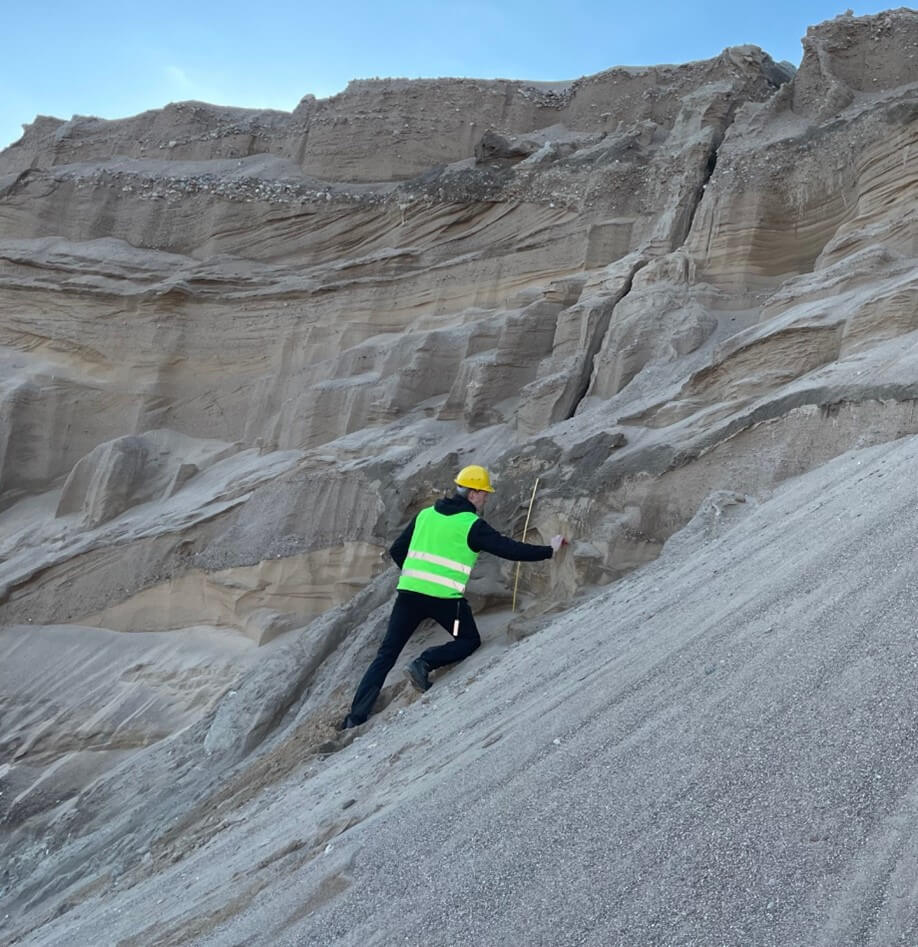
Today, the research and classification of these landforms is difficult due to often scattered outcrops such as active gravel pits and rapid changes in their lithologies. In addition to the existence of an outcrop, it has to be representative enough. There is constant pressure not to excavate these ice-marginal systems extensively due to their groundwater potential, but to gain conclusive information on the structures of these landforms, excavations to some extent are essential.
Sedimentological 3D model and groundwater flow model of the Huhtainnummi complex serve both genetic understanding and practical application of the landform, which acts as a groundwater reservoir for nearby municipalities and as a significant gravel extraction site for manufacturing concrete products. In addition, we will illustrate how detailed and extensive observations of architectural information on these intricate ice-marginal complexes can be obtained through outcrop investigation and geophysical methods compared with analyses based solely on geomorphology and lithological interpretation. This project provides new insights into the interpretation of architecturally intricate and societally important ice-marginal environments. To complement morphology- and lithology-based mapping, especially for ice-marginal complexes, additional stratigraphic approaches, including the allostratigraphic approach used in this project, are needed.
14.4.2026