
Farid Mousavi Janbehsarayi, University of Oulu, Farid.Mousavi@oulu.fi
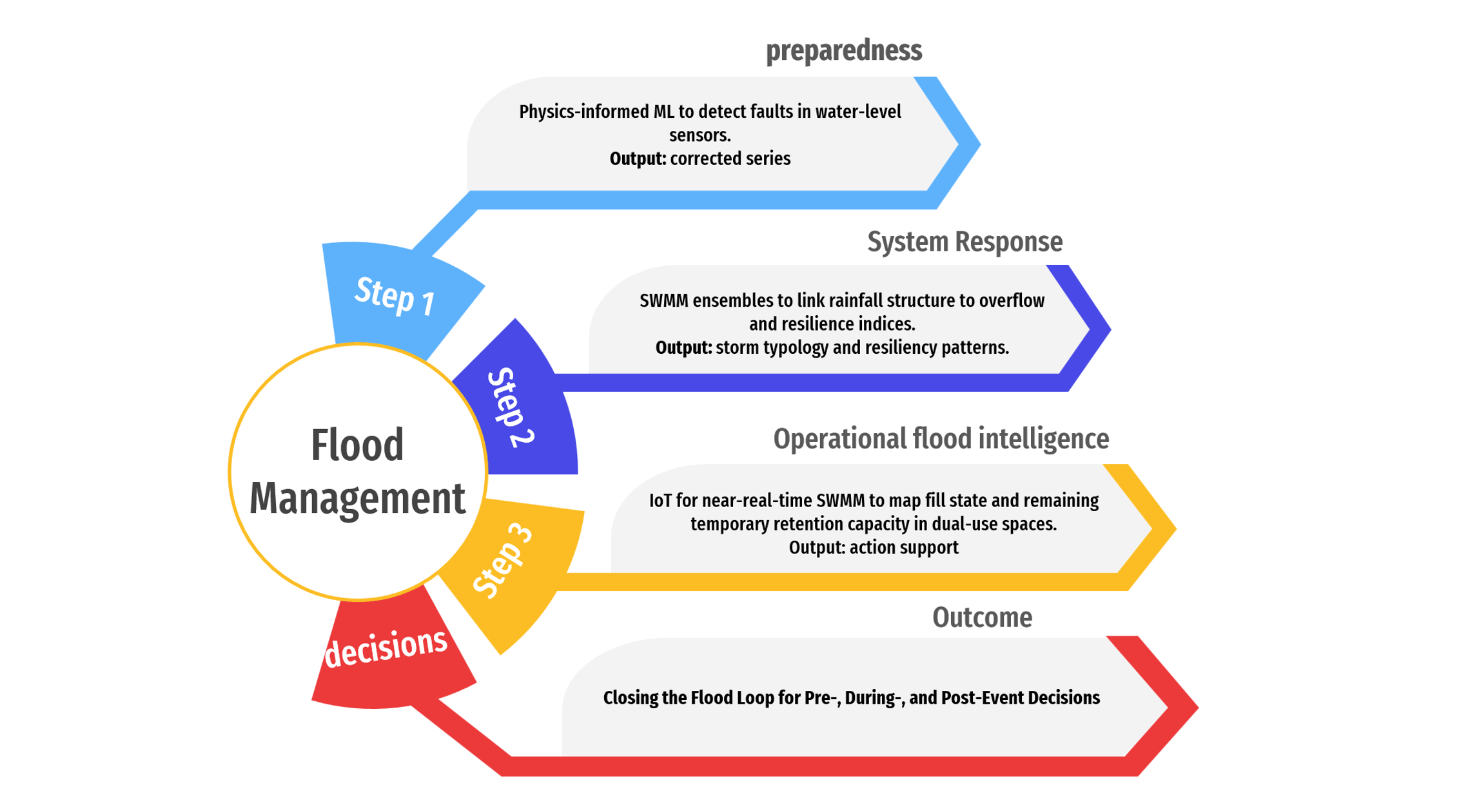
As cities become more complex, stormwater systems are no longer just pipes, manholes, and channels hidden beneath the streets. They are evolving into monitored, data-driven networks that rely increasingly on sensors to understand what is happening in real time. This transforms everything, because in urban flood management, data is not just information; it also provides awareness, response time, system intelligence, and sometimes it makes the difference between a controlled event and an urban disaster. This is why fault detection in flood sensors is a crucial area of research. Following the monitoring and analysis of system responses to events is of vital importance. The concept of resilience can be employed here to address system performance analysis. Of course, if the system is unreliable, measures and plans should be implemented, whether through strategies such as low-impact development, redesign, or real-time management using the Internet of Things.
The Hidden Risk Behind “Reliable” Data
Flood sensors are often treated as silent observers in urban drainage systems. They measure water levels, flow conditions, surcharge events, overflow risk, and overall system behavior during storms. These measurements support flood forecasting, operational decisions, early-warning systems, digital twins, and long-term infrastructure planning. But what happens when the sensor itself is wrong? That question matters more than it may seem.
A faulty sensor can create a false sense of safety. It may miss a rapidly rising water level, report unrealistic values, or generate noisy and misleading signals during critical storm events. In practice, this means engineers and operators may be making high-stakes decisions based on data that appear precise but do not reflect reality. Therefore, fault detection is not only a technical issue, but it is a resilience issue.
Resilient Systems Require Trustworthy Data and Intelligent Modeling
When we talk about the resilience of urban stormwater and flood conveyance networks, we often focus on hydraulic capacity, redundancy, overflow structures, detention systems, or climate adaptation strategies. But resilience is also about whether the system can still be understood, monitored, and managed when part of its sensing infrastructure begins to fail. A resilient drainage network is not only one that continues to convey water under stress. It is also one that continues to deliver trustworthy information under stress. That is where intelligent fault detection becomes powerful.
In my research, I am integrating the Storm Water Management Model (SWMM) based physical modelling concepts with sensor behavior analysis. The goal is to detect abnormal sensor behavior early and distinguish between a true flood signal and a measurement error. As cities transition toward smart stormwater systems, this integration becomes increasingly important. Urban drainage networks are shifting from passive infrastructure to active, data-driven systems. Sensors are no longer used solely for observation; they now support control, prediction, and automated response. In such environments, sensor reliability becomes inseparable from infrastructure reliability. This is the reason why my research in this area matters. It sits at the intersection of urban flooding, sensing technology, infrastructure monitoring, and system resilience.
Smarter flood protection with IoT-powered dual-use urban spaces
Cities are seeing more intense bursts of rainfall, and traditional drainage systems are often not built to handle them. When too much rain falls in too little time, pipes can quickly reach capacity, leaving streets, intersections, and public spaces flooded. To deal with this, cities are beginning to rethink everyday urban spaces, not just as places for recreation or transport, but also as part of the flood solution.
Parks, plazas, sports fields, and even parking lots can serve a second purpose during storms to temporarily store excess rainwater and release it later, once the pressure on the drainage system has eased. These “dual-use” spaces offer a practical and flexible way to reduce flood risk without building entirely new infrastructure. But making them truly effective requires more than just design, as it requires intelligence. That is where IoT comes in. While many flood monitoring systems can detect rising water levels, few are able to translate that information into real-time operational decisions. In other words, cities may know flooding is happening, but not always how much storage capacity is still available in these temporary retention spaces, or when they should be activated, closed, or prioritized for emergency response.
Our work focuses on changing that. We are developing and testing an IoT-based, real-time floodwater tracking system that helps cities understand exactly how much stormwater is being stored in designated floodable spaces such as parking lots, parks, and low-lying road junctions during extreme rainfall. By combining rainfall data with on-site sensing, the system can continuously estimate how full these spaces are and how much capacity remains.
10.4.2026