Parsa Parvizi, University of Oulu, parsa.parvizi@oulu.fi
Beneath every stream network lies a hidden force: groundwater, quietly shaping life below the surface. This underground water helps regulate stream temperature and supports the health of river ecosystems, from fish to plants. Studying how groundwater and surface water interact is crucial because these connections influence stream conditions, aquatic habitats, nutrient cycles, and overall water quality. By moderating temperature, groundwater creates stable environments that sustain biodiversity in fragile ecosystems. Understanding these processes also helps us to predict how climate change and land use may alter freshwater systems, guiding conservation efforts.
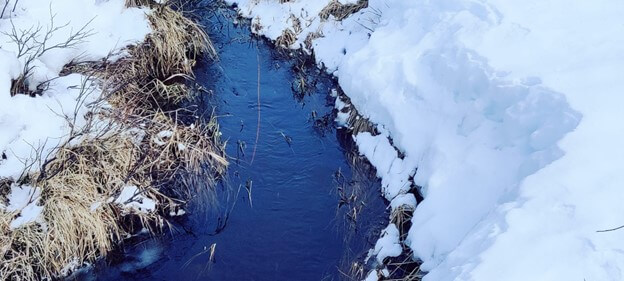
Groundwater is like nature’s thermostat. In summer, it seeps into streams cooler than the surface water, offering fish and insects a refuge from the heat. In winter, it does the opposite, keeping small sections of the stream from freezing completely, so aquatic life can survive. Without this steady underground inflow, streams in northern landscapes could swing wildly in temperature, stressing sensitive species and disrupting nutrient cycles. Studying these interactions helps us understand not just how streams work today, but how they might change as the climate warms.
Chasing Hidden Water Behavior with Technology
In my doctoral study at the Pallas Lompolojängänoja (LJO) headwater catchment in northern Finland, we used Distributed Temperature Sensing (DTS) technology to study how groundwater affects stream temperature (Picture 1)(Croghan et al., 2022). By placing a fiber-optic cable along a 2 km stream, we measured water temperature every 2 meters and every 30 minutes. These detailed temperature records allowed us to detect where and when groundwater entered the stream and how these inflows changed with the seasons. Because groundwater stays cooler in summer and warmer in winter than surface water, it plays a key role in regulating thermal conditions year-round.
Adding the Power of Hydrological Models
To gain a broader understanding of groundwater-surface water interactions, I complemented the DTS observations with simulations from the SpaFHy-2D hydrological model (Nousu et al., 2024). SpaFHy-2D is an advanced, process-based model designed to represent water movement through soil and vegetation across heterogeneous landscapes. The DTS-derived temperature data were used to evaluate the model’s ability to simulate the spatiotemporal dynamics of groundwater and lateral inflows to the stream under varying hydrological conditions. Integrating high-resolution field observations with physically based modeling offers a powerful approach for assessing how sub-Arctic freshwater systems may respond to shifts in groundwater recharge, streamflow, and temperature regimes under a warming climate. This combined framework enhances our capacity to predict and manage the impacts of environmental change on sensitive headwater ecosystems
What We Found and what is to come?
Our results showed that groundwater inflows are not constant; they vary through the year, often strongest in late winter and spring when snowmelt recharges the ground. These inflows created thermal refuges; warmer patches in winter and cooler ones in summer, helping ecosystem cope with extreme conditions. Therefore, groundwater contributions showed a significant influence on stream temperature and overall ecosystem stability. Model simulations using SpaFHy-2D confirmed these observations, accurately predicting that areas with stronger groundwater inflows remained thermally buffered throughout the year. Without these interactions, stream sections would experience deeper freezing during winter and higher temperature peaks in summer, conditions that could threaten aquatic biodiversity and disrupt critical ecological processes.
This research isn’t just about one small stream in Finland; it’s part of a larger story about how climate change affects cold-region water systems. If warming trends continue, reduced snowmelt and shifting precipitation could weaken groundwater inflows, leading to hotter, drier streams. Understanding these processes gives scientists and policymakers the tools to protect critical habitats and plan for future water management. Groundwater might be invisible, but its influence is everywhere. By pairing technology like DTS with modeling predictions, we can finally start to see and protect the life flowing beneath our streams.
22.10.2025.
References
- Croghan, D., Khamis, K., Hannah, D., Martinkauppi, I., Ala-Aho, P., & Marttila, H. (2022). Visualization of Distributed Temperature Sensing shows fine-scale water temperature dynamics in a subarctic stream over melt season. https://doi.org/10.22541/au.165097636.60397052/v1
- Nousu, J.-P., Leppä, K., Marttila, H., Ala-aho, P., Mazzotti, G., Manninen, T., Korkiakoski, M., Aurela, M., Lohila, A., & Launiainen, S. (2024). Multi-scale soil moisture data and process-based modeling reveal the importance of lateral groundwater flow in a subarctic catchment. Hydrology and Earth System Sciences, 28(20), 4643–4666. https://doi.org/10.5194/hess-28-4643-2024