Iiro Seppä, University of Turku. iielse@utu.fi
At the end of November, I spent two weeks with the Machine learning in Earth Sciences group at Interdisciplinary Transformation University (IT-U) in Linz, Austria.
Planning the visit
The idea for the visit originated in April 2025. I had noticed that a research group in Austria was involved in many of the foundational articles for deep learning rainfall-runoff modelling, my research topic. I thought that a research visit could be really useful for me, in order to get feedback on my research ideas from those doing cutting-edge research. I happened to notice that the leader of that research group was giving a poster presentation at EGU25, where I was also going. Therefore, I decided to just go and talk to him and ask if a research visit was possible. After a good discussion, the answer was yes! Now, there were just a few practicalities to sort out:
when to go, for how long, and, most importantly, what exactly I should do once there. The duration of the visit was easiest: There was enough travel funds left for two weeks visit, and I didn’t want to go to the trouble of applying for extra. I decided to time the visit so that the methodologies of the second article could be honed to their final form in Linz, which also informed the planned activities. Before the visit, I asked about ongoing lectures and possibilities to present my research. This was a good idea, as I was able to plan my timetable around interesting lectures and was given two proper presentation times for different audiences.
Arrival in Linz and activities during the visit
At IT-U, everything went quite smoothly. I received a desk and keycard without a hitch, and everybody was really nice and friendly. The university is small and the newest of many universities in Linz, which is a bit surprising as the city has a population of 200 000, similar to my home city of Turku. Apparently, Austrians like to have many small universities instead of one big one. I knew that the working culture in German-speaking countries could be more formal than in Finland, so I was pleasantly surprised by flat hierarchies and an informal way of communicating. Most of the time was spent on the methods of my second article, which focuses on the importance of different variables for making good streamflow predictions in the boreal zone.
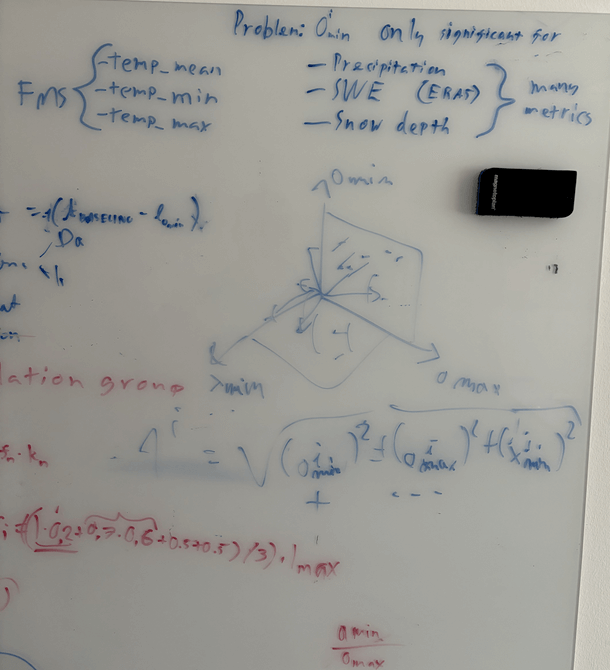
It was really nice to get to talk deeply about the methodologies, and a relief to get confirmation that, overall, my ideas were reasonable, even if slight tweaks could be made. Especially during the second week, there was a fast developmental cycle for the methodology, as I put simulations running overnight, analyzed the results in the morning, and we discussed the implications and possible modifications in the afternoon, leading to the next night’s simulations. At the end, the methodology was deemed robust enough to be put into action. There were a lot of other activities: I presented my research and plans, attended lectures on advanced machine learning, and learnt new features of important techniques. I also formed connections with other PhD students and staff, both on campus and at a couple of after-work events at restaurants. Overall, I am grateful to my host, Daniel, for making this visit possible and also taking time from his busy schedule for lots of discussions. I believe that this trip was just the beginning of a collaboration.
Freetime after work
As you can probably gather from the previous section, I worked quite intensively during the visit and needed to recover during the evenings. For me, the best way to relax after mentally taxing work is to do endurance sports. Thus, I spent the evenings exploring the city and surroundings by running, tested local climbing gym and swimming hall, and even managed to obtain a sprint orienteering map from Linz naturfreunde, which I promptly put to the test (it was good practice for thinking about the elevation when choosing a route).
I actually encountered the biggest culture shock of the journey while going to exercise. I knew that Austria uses much more cash than Finland, and I had taken some banknotes with me. However, I was wholly unprepared for the fact that all lockers in climbing gyms and swimming halls required coins to work. The last time I needed coins for anything in Finland was well over a decade ago, and obviously, I didn’t have any with me. Luckily, a friendly stranger noticed my distress and gave me a coin that I used for the rest of the journey.
Visiting Austria was also a great opportunity to put my German skills to the test. I have studied some German by myself, but haven’t had many opportunities to practice speaking. I was pleased to find out that I could handle everyday situations completely in German, even if I sometimes had to ask the other person to repeat the question.
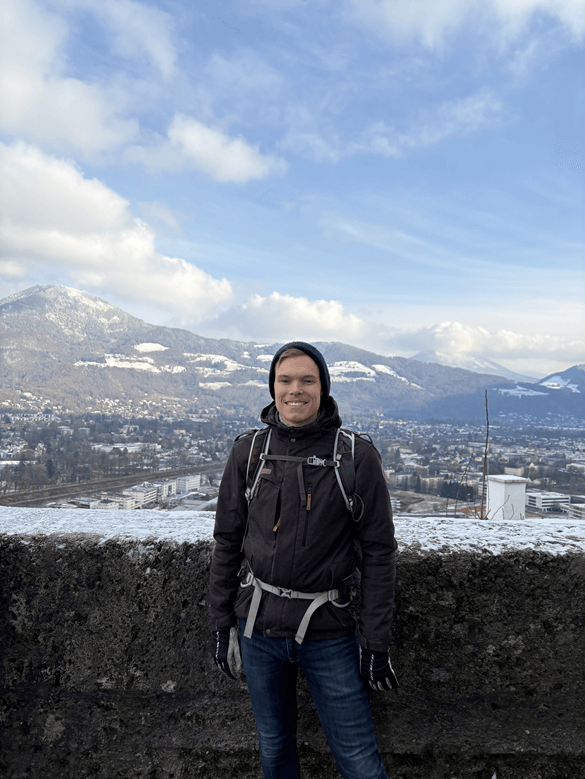
One of the highlights of the journey was the weekend. My wife came over to visit, and we travelled to Salzburg, toured the historical city centre, including the famous Christmas markets, and also went to see the Hohensalzburg fortress. The weather was nice and clear, especially on Sunday, when the surrounding mountains showed up in all their magnificence.
Key takeaways
- If you find a researcher who is doing something interesting and you think that a research visit could be useful, just go on and ask! The worst they can say is no.
- Plan a bit of the program, but also leave time for discussion and exploring new ideas
- Remember to explore the location and find time for relaxing
Danke schön, Linz, Pfiadi!
15.1.2026