
Henri Heiskanen, Aalto University, henri.heiskanen@aalto.fi
Streamflow, or river discharge (Q), is a core variable in hydrology. It describes the volume of water passing a given river cross-section per unit time and is required for watershed water balance calculations as well as for practical water resources management, including flow regulation and flood mitigation.
Conventional streamflow measurements are based on observations of flow velocity across a river cross-section combined with corresponding channel geometry. Historically, these measurements were carried out using mechanical current meters with propeller-based sensors. More recently, acoustic Doppler current profilers (ADCPs), which rely on hydroacoustic measurement principles, have become the standard approach. Continuous discharge monitoring is typically achieved by relating discrete discharge measurements to the water level observations through the development of rating curves. Once established, these relationships allow discharge to be estimated from water level data.
In Finland, approximately 280 hydrological gauging stations operate on this principle and cover most major rivers (SYKE). The development of this network has taken more than a century, and its operation requires regular maintenance and repeated field measurements to verify rating curves. Being a labor-intensive and costly process, substantial numbers of mid-sized and small rivers remain unmonitored. In this context, new observation techniques are welcomed.
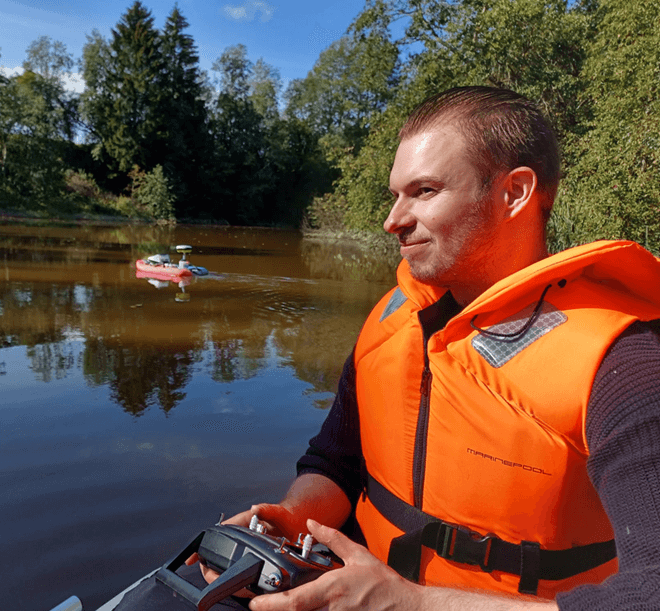
Image velocimetry as an alternative to conventional techniques
Have you ever watched ripples moving across a river surface and wondered whether that visible motion could be measured to estimate streamflow? Over the past two decades, advances in optical sensing, image processing, and machine vision have made this possible.
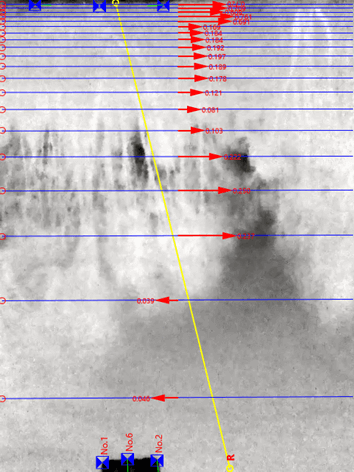
Image-based velocimetry methods estimate surface flow velocities by tracking naturally occurring tracers, such as foam, bubbles, or surface texture, in video imagery.
Techniques such as large-scale particle image velocimetry (LSPIV) (Muste et al. 2008), particle tracking velocimetry (PTV) (Brevis et al. 2011), and space-time image velocimetry (STIV) (Fujita et al. 2007) differ in how motion is extracted from image sequences, but they share a common advantage. They enable non-contact, flexible, and increasingly cost-effective streamflow monitoring. These methods open new possibilities for expanding hydrological observations to previously ungauged rivers and challenging environments, while also offering less laborous and more financially feasible alternatives to conventional techniques.
Camera systems at DIWA supersites
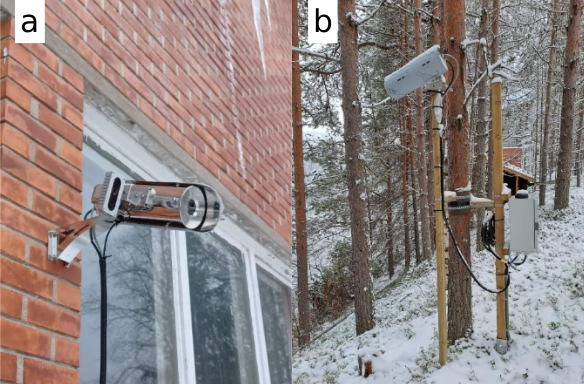
As part of my PhD studies within the Digital Waters Flagship, I am involved in piloting, assessing, and developing static camera systems for river flow monitoring using image velocimetry techniques. A set of two different types of cameras has been installed at the Oulankajoki and Vantaanjoki River supersites, recording videos across the river at hourly intervals. The first type of camera consists of a conventional RGB camera operating in the visible spectrum of light, analogous to human vision. The second camera is a thermal camera installed in parallel with the RGB camera. It operates in the thermal infrared region of the spectrum, enabling flow observations during night-time and other low-light conditions. The monitoring setup is designed to allow near-continuous observation of streamflow whenever surface motion can be detected in the camera imagery. In an ideal case, the recorded videos can be transferred near real-time to image velocimetry algorithms and processed into streamflow observations.
Supporting next-generation hydrological observation and development of digital twins
The streamflow observation results derived from the camera data form a central component of my first PhD publication. As a researcher within the Digital Waters (DIWA) Flagship, I consider it highly meaningful to test, assess, and further develop next-generation hydrological observation techniques. In the longer term, camera-based streamflow monitoring stations could complement existing hydrological observation networks in a cost-efficient manner and help extend their spatial coverage. This could improve real-time awareness of water resources, particularly in catchments where conventional gauging is sparse or absent. Such observations could be integrated into watershed-scale digital twins, in which multiple sensor systems are interconnected and provide a continuous interface between real-world hydrological processes and their digital representations.
References
- Brevis, W., Niño, Y., & Jirka, G. H. (2011). Integrating cross-correlation and relaxation algorithms for particle tracking velocimetry. Experiments in Fluids, 50(1), 135–147. https://doi.org/10.1007/s00348-010-0907-z.
- Finnish Environment Institute (SYKE). (2024). Hydrologiset havaintopaikat. https://ckan.ymparisto.fi/dataset/hydrologiset-havaintopaikat.
- Fujita, I., Watanabe, H., & Tsubaki, R. (2007) Development of a non-intrusive and efficient flow monitoring technique: The Space Time Image Velocimetry (STIV). Int J River Basin Man, 5(2), 105–114. https://doi.org/10.1080/15715124.2007.9635310.
- Muste, M., Fujita, I., & Hauet, A. (2008). Large‐scale particle image velocimetry for measurements in riverine environments. Water Resources Research., 46(4). https://doi.org/10.1029/2008WR006950.
27.1.2026