Dimitrios Kampantais, Åbo akademi. dimitrios.kampantais@abo.fi
Rocky‐Shore Biodiversity and the Role of Fucus vesiculosus
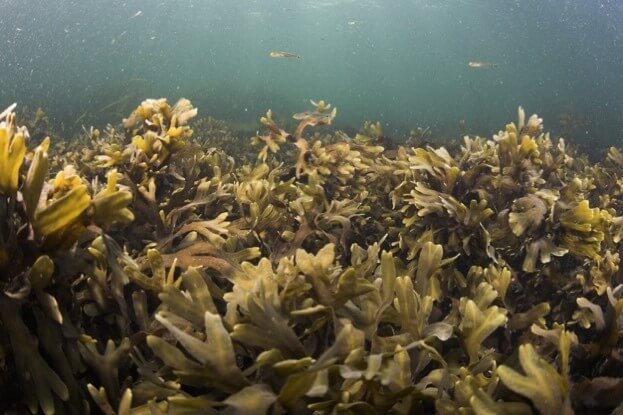
The Baltic Sea, an almost nontidal shallow marine ecosystem, is one of the world’s largest brackish environments. Its salinity and limited water exchange support a unique assemblage of both marine and freshwater organisms, all woven into a single, brackish‐water food web. On most of its rocky shores, the dominant habitat‐forming organism is the bladderwrack, Fucus vesiculosus. These perennial brown algae form dense belts along coasts or even around islands
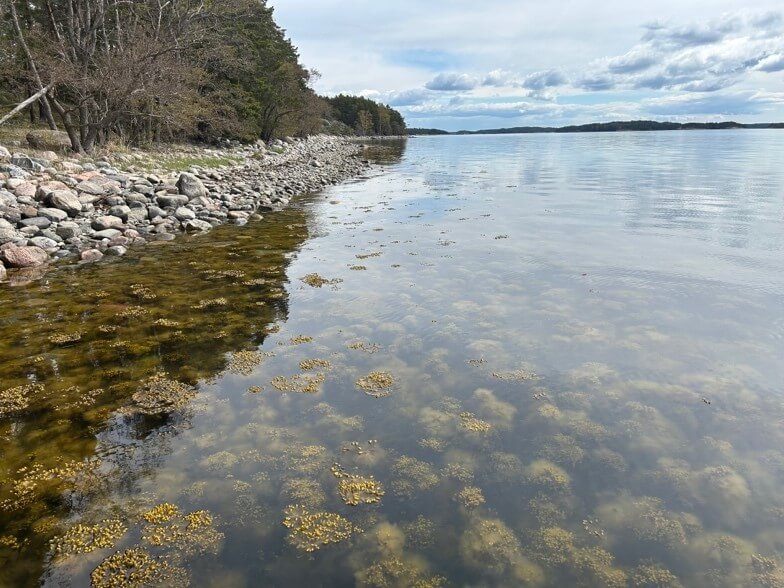
Much like corals on tropical reefs or the canopy of a rainforest, bladderwrack provides a three‐dimensional structure crucial to coastal biodiversity.
Habitat and nursery: Over fifty invertebrate species and several fish (e.g., cod, perch, pike) reside in and use the algae for shelter, feeding, and recruitment.
Ecosystem engineering: Areas with healthy F. vesiculosus can support significantly greater invertebrate communities than bare rocks.
Ecosystem services: Aids in carbon fixation, eutrophication, improvement of water quality and clarity, sustains the ecosystem function, provides landscapes for diving and snorkeling, contributes to the cultural identity of Baltic coastal communities.
Ferry Traffic as an Anthropogenic Disturbance and a Double-Edged Sword
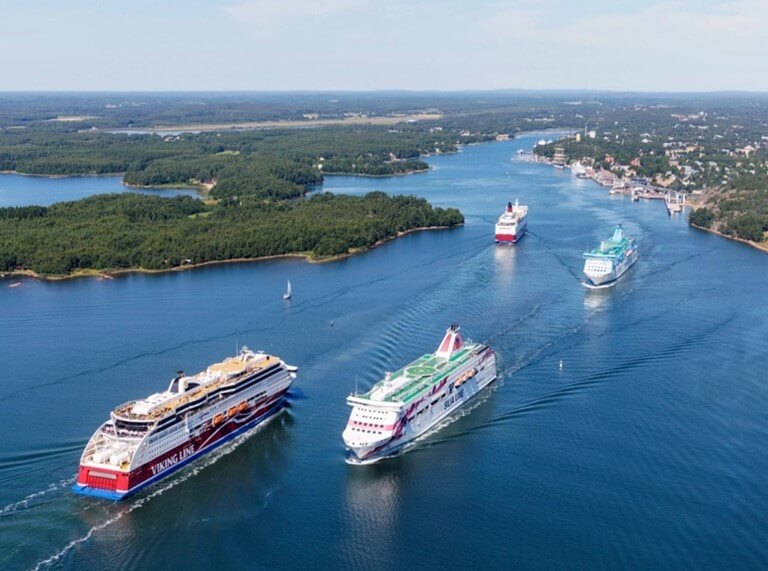
Many anthropogenic pressures are affecting the biodiversity of the Baltic’s rocky coasts (eutrophication, hazardous substances, invasive species, noise, fishing, and climate change). Among these, commercial and recreational ferry traffic is a chronic, non‐stop stressor that underpins regional economies. Each ferry passage is responsible for inducing waves with different properties than naturally occurring wind waves that can swiftly and unpredictably reach and affect normally non-wind-inflicted shorelines and modify nearshore hydrodynamics in distinct ways:
Moderate wave intensity can nonetheless “clean” the rocky substrates, an effect likened to a natural broom, sweeping away excess algae and making it easier for young Fucus to attach and develop into dense stands that support diverse and abundant invertebrate communities. However, when wave intensity exceeds certain thresholds, it becomes detrimental by causing:
- Erosion of shorelines
- Resuspension of sediments, reducing light penetration, and algal photosynthetic ability
- Algae breakage, uprooting, inhibited reproduction, and growth
- Invertebrates’ dislodgement, altered community composition – selective loss of sensitive species, dominance of more tolerant opportunistic taxa
Despite the growing body of research, the critical thresholds for invertebrates affected by ferry‐wave disturbance in F. vesiculosus habitats remain poorly quantified. Without this knowledge, we do not know the extent so far and cannot predict whether ferry waves will ultimately benefit or harm rocky‐shore communities.
Research objectives
To elucidate the ecological consequences of ferry traffic on Baltic rocky‐shore biodiversity, I will:
- Compare biotic communities
Assess how Fucus‐associated invertebrates’ composition and abundances differ at sites subjected to high versus low ferry‐wave exposure along the Finland–Åland Islands route. - Quantify hydrodynamic regimes
Deploy wave measuring loggers to record wave intensity, current velocity, light penetration, sedimentation rates, and water level fluctuations. - Identify disturbance thresholds
Pinpoint the wave‐energy thresholds that push algal belts and their associated faunal communities from healthy stability into stress and decline. - Characterize species‐specific responses
Determine which invertebrate taxa thrive or decline under different wave‐disturbance regimes.
Ferry disturbance thresholds for sustainable Baltic shores
By understanding the links between physical forces and ecological responses, scientists and managers can better predict changes and implement measures and smart solutions to protect biodiversity on the Baltic’s rocky shores. By defining disturbance thresholds, we can help ensure that commercial ferry transport and healthy coastal ecosystems coexist sustainably in the Baltic Sea.
References
- Bishop, M.J. (2008) ‘Displacement of epifauna from seagrass blades by boat wake’, Journal of Experimental Marine Biology and Ecology, 354(1), pp. 111–118.
- Eriksson, B.K. et al. (2004) ‘Effects of boating activities on aquatic vegetation in the Stockholm archipelago, Baltic Sea’, Estuarine, Coastal and Shelf Science, 61(2), pp. 339–349.
- Gabel, F. et al. (2012) ‘Effects of ship‐induced waves on littoral benthic invertebrates’, Freshwater Biology, 57(12), pp. 2425–2435.
- Hofmann, H. et al. (2008) ‘Wave-induced variability of the underwater light climate in the Littoral Zone’, SIL Proceedings, 1922-2010, 30(4), pp. 627–632.
- Rapaglia, J. et al. (2015) ‘Ship-wake induced sediment remobilization: Effects and proposed management strategies for the Venice Lagoon’, Ocean & Coastal Management, 110, pp. 1–11.
- Rinne, H. and Salovius-Laurén, S. (2019) ‘The status of brown macroalgae Fucus spp. and its relation to environmental variation in the Finnish marine area, northern Baltic Sea’, Ambio, 49(1), pp. 118–129.
- Rinne, H. et al. (2022) ‘Variation in Fucus vesiculosus associated fauna along a eutrophication gradient’, Estuarine, Coastal and Shelf Science, 275, p. 107976.
- Wikström, S.A. and Kautsky, L. (2007) ‘Structure and diversity of invertebrate communities in the presence and absence of canopy-forming Fucus vesiculosus in the Baltic Sea’, Estuarine, Coastal and Shelf Science, 72(1–2), pp. 168–176.
- Kampantais Dimitrios, Fucus vesiculosus belt in the south shore of Skjåldholmarna in the Archipelago Sea, May 2025.
- Hannula, Marko. “Four Baltic Sea Cruise ferries in the Mariehamn Channel.” iStock, 30 July 2021, https://www.istockphoto.com/photo/large-passenger-ferries-arriving-and-departing-from-mariehamn-harbor-mv-rosella-gm1332826906-415557339.
- Kunz, Uli. “Bladderwrack Forest, Southwestern Baltic Sea.” Ecology and Evolution, 23 July 2019, https://cdn.ncbi.nlm.nih.gov/pmc/blobs/890d/6706220/4c532a16b37e/ECE3-9-9225-g001.jpg.
29.5.2025.