
Mohammadreza Hassani, Aalto University, mohammadreza.hassani@aalto.fi
Some research topics do not begin in a laboratory. They begin outside on a hillside, beside a road under construction, or at the edge of a catchment that is quietly changing shape. That is where my PhD work lives. We often talk about urbanization as if it were a finished condition: more roads, more roofs, more pipes, more runoff. But what truly matters is the transition itself — the messy, dynamic period when a catchment is no longer fully natural, yet not fully urban either. That period matters greatly because stormwater does not wait for construction to end.
The Hydrologic Impact of Disturbance & The Saunalahti Catchment
As vegetation is removed, soils are exposed, slopes are reshaped, and drainage pathways are modified, both the quantity and quality of runoff can change dramatically. Water moves faster, sediment becomes easier to mobilize, and pollutant pathways shift (Sillanpää and Koivusalo, 2015). Yet in many practical discussions, the construction phase is treated as a temporary side note rather than one of the most critical hydrologic stages in urban development. Urban development is not only a land-use story.
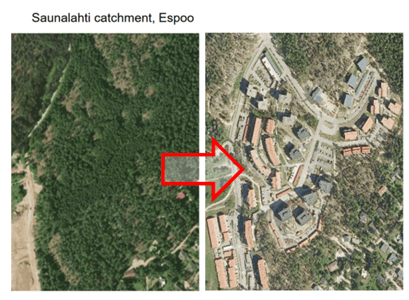
One case study that illustrates this transition is the Saunalahti catchment in Espoo, Finland. Before construction began in 2001, the area was predominantly coniferous forest. Over the following years, it was transformed into a residential neighborhood. Construction began with road and storm sewer works in 2001. Imperviousness remained below 2% in the early years, then increased rapidly, reaching approximately 37% by late 2006. This case tells us not just about the before and after of urbanization, but the during.
Modeling the “What If” Scenario
To properly study developing catchments, we must ask a fundamental question: How would the catchment have behaved if construction-related disturbance had not occurred? To explore this, I use the Storm Water Management Model (SWMM) framework in my research.
A nearby stable urban catchment serves as a reference basin. Its pollutant behavior is transferred to the developing catchment to create a baseline scenario. In simple terms, we train SWMM on finalized urban behavior and then simulate those conditions during the development years. The differences between modeled results and field observations help isolate the specific effects of active construction.
Initial field monitoring indicates that the probability of observing higher pollutant concentrations in the disturbed catchment — compared to the stable reference — can rise to 70–75% at construction hotspots. To stormwater researchers, that says something important: If we only model cities once they are stable, we miss one of the most environmentally sensitive phases in the entire urbanization process.
Why This Matters for Research and Practice
What makes this work exciting to me is that I am not only describing change — I am trying to quantify it. I believe that there is still substantial room for future research. We need stormwater models that better represent dynamic, construction-stage processes rather than assuming static land-use categories.
Most importantly, this science must inform practical decisions:
- Erosion and sediment control
- Temporary drainage design
- Phased construction planning
- Construction-era stormwater management strategies
Urban construction is not a brief interruption between two stable states. It is a hydrologically active and environmentally sensitive phase, and it deserves to be studied as such.
References:
- Sillanpää, N., & Koivusalo, H. (2015). Stormwater quality during residential construction activities: influential variables. Hydrological Processes, 29(19), 4238-4251.
4.4.2026