
Janne Torvela, University of Oulu, janne.torvelaoulu.fi
A week into deployment, our newly installed ice-monitoring sensor reported it had run out of power and stopped transmitting data. So, I trudged across a lake in the freezing cold to find the broken equipment and fix it. After swapping the batteries and restoring function, I realized that we had an unexpected gift: a week’s worth of high-frequency data to compare against our usual sparse sampling. A small annoyance turned into a fortunate failure.
A fortunate failure
The radio transmitter on Lake Kuivasjärvi had failed only a week into its deployment. Normally, it wakes up, sends a packet of data, and sleeps for an hour. On the last Friday of January, the data stopped coming. We found the logs full of messages, transmitted as fast as the radio could send, until the batteries went flat. The unit sits in a tripod in the middle of the frozen lake, close enough to walk to but far enough that the decision to go depends on how much you like cold toes. The sky was crisp and blue, and the air was merciless -19 C that day. I packed the necessary: a small folding table and tools. Walking through an expanse of squeaky snow, you can tell the temperature just from the noise it makes.
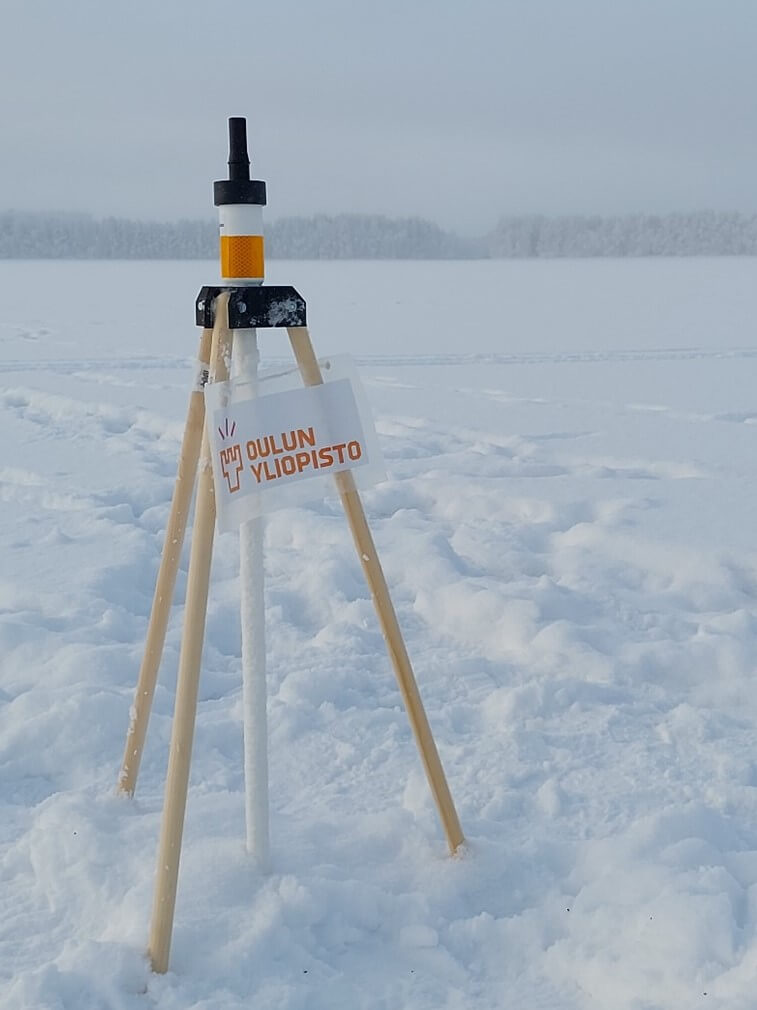
It’s less annoying if you don’t think about the distance or the time, or the cold turning your face numb and prickly, but simply move. At the unit, the symptoms were obvious: it was dead with no power. Physically, the circuit boards seemed fine – no obvious mechanical damage. As I turned the unit sideways, I noticed one lifted solder joint. One pad was torn off with the connecting pin sticking it up like a tiny cocktail umbrella. In the cold, tin solder becomes brittle, which is a concern these days since we’re not allowed to add lead to soften it up. Harder metals such as copper and silver are added instead. I’d seen these cold fractures before; I just couldn’t figure out what made it pop up like that.
Field Repair at −19 °C
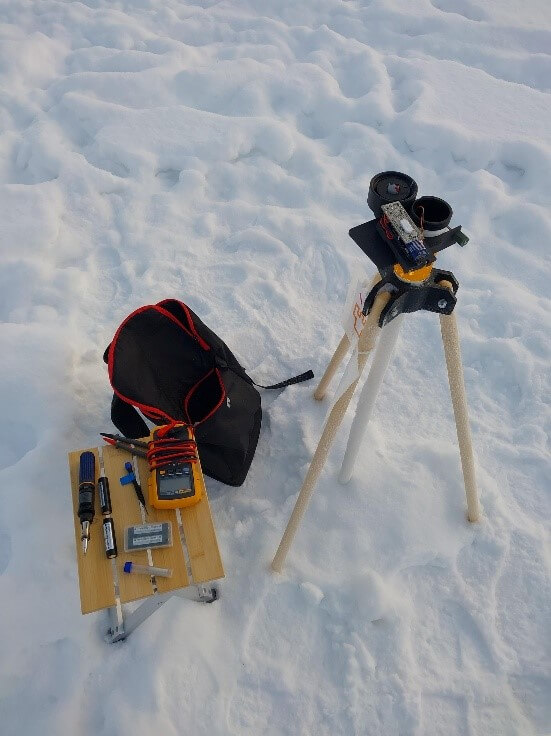
Replacing the radio wasn’t an option, so the repair had to be surgical: reflow the broken joint and build a solder bridge to the remaining trace on the circuit board. I unpacked my gas torch, which I usually reserve for fixing cables and connectors. It’s a crude tool for fine electronics, but it does the job in a pinch. That is, if this were summer. Butane gas doesn’t vaporize in extreme cold. I tried holding the torch in my bare hand to warm the gas while it was boiling away inside the tank, becoming colder and colder. Even equipment designed for “field use” assumes a range of operating temperatures, and -19 below is quite rude on most.
Still, the joint needed heat. The torch was emitting an exhaust that froze into a little cloud that hung around. I worked quickly, melting the old solder and pushing in a strand of new stuff. It’s a precise kind of hurry: too fast, and you make a cold joint that will fracture again; too slow, and you burn the resin board and make a charred mess. Working the molten tin too much will make slag that won’t stick properly. It’s a job that is best done decisively, succeed or fail.
I put the torch down on the folding table to inspect my work. When I picked it back up seconds later, the flame was out, and the iron was cold. The gas had frozen. Oh well. I replaced the batteries and switched the power back on. Moments later, I saw the radio message on my phone. Once and no more, at least for another hour. By the time I started heading back, an ice fog had formed, which made the distant trees look like they were swimming in blue-grey water. With the visibility falling, I had some trouble finding the end of the path between the trees that led out of the lake – but there it was. I had been out for maybe an hour and a half, not long at all. All done.
On the way, I thought about what had happened with the transmitter. Rebooting for a failure to shut down every two minutes gave us approximately a week’s worth of high-resolution measurements compressed into the period around the fault. That oversampling will let us compare the usual sparse time series of data of the same system against a dense portrait in similar conditions. We didn’t design the device to operate like this because it wouldn’t play nicely with the radio network to reconnect repeatedly, but it worked anyway. A failure in other terms became an opportunity.
This is practical fieldwork and prototyping. We build stuff, we put it out there, maintain it, and see what happens. The repair was a small victory over the elements, and the radio transmitter is working again as designed. It will keep measuring the conditions of the ice until spring thaws, and then we’ll have to figure out a way to extract it before it falls in, without falling in ourselves.
Any suggestions? Perhaps a small inflatable rubber boat?