Alexandra Nyberg, Åbo Akademi, alexandra.I.nyberg@abo.fi
I’ve participated in a conference before (Nordic Geological Winter Meeting 2024), but then as a Master student with a poster presentation. This time, the 10th International Acid Sulfate Soil Conference [1], was my first time as a PhD student with an oral presentation. The conference was held September 15–17, in Luleå, Sweden.
For this conference, I submitted an abstract with the title “Effects of gypsum treatment on acid sulfate soils in W Finland”. The aim was to present preliminary results of the geochemical effects on water quality, which will be part of my second article.
What are acid sulfate soils?
Before going into my conference experience, I’ll briefly introduce acid sulfate soils, the subject of the conference.
Acid sulfate soils are naturally occurring soils and sediments that contain iron sulfides. Acid sulfate soils are problematic due to their potential to produce sulfuric acid by oxidation of sulfidic minerals in the soil. Acidification (pH <4) of soil mobilizes elements, which leads to leaching of acid and mobilized elements into recipient waters, and these elements include potentially toxic metals [2]. Due to these properties, they are often referred to as “the nastiest soils in the world” [3]. In Finland, acid sulfate soils are prevalent in near-coastal areas, mainly below the highest coastline of the Littorina sea, as the typical parent material was deposited during the Littorina and post-Littorina Sea stages. They are uplifted due to post-glacial isostatic uplift and exposed to oxygen mainly due to artificial draining [4].
Pre-excursion
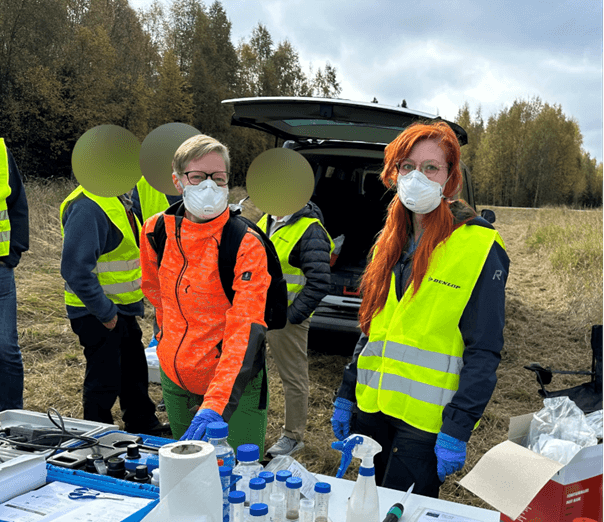
My supervisors, Miriam Nystrand and Peter Österholm, were asked to demonstrate the Åbo Akademi University (ÅAU) rapid field method protocol on the pre-excursion day, and I assisted since I’m also familiar with the method. With this method, we can do a rapid identification and risk assessment of acid sulfate soils while still in the field. The key steps of the method are: 1. Field pH, 2. Identification of potential acid sulfate soil with hydrogen peroxide, 3. Identification and risk assessment with EC and sulfate, and 4. Risk based on acidity. If you’re interested, you can find more information in the Tunnistus project report [5] (in Finnish).
Conference days
Attending a conference where you are looking forward to every presentation is exciting! I had my own presentation scheduled for the second day, which made me slightly stressed during the first day, but I mostly forgot about it thanks to the interesting presentation topics.
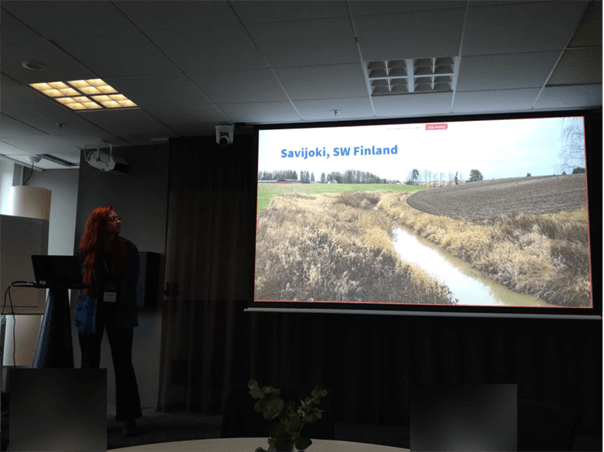
As some of you may relate to, I am one of those people who feel very nervous and anxious about talking in front of a large group of people. I was also nervous about the fact that I would be talking to the experts in this research field and felt like “I know nothing”. Although these feelings are common, they are all just in your head. Most of the other conference participants have probably been in the same situation themselves while being early-career researchers. All in all, I survived, I got great feedback, and many people were interested in my research! A big relief and confidence boost. One of the days ended with a conference dinner, a fun social gathering to get to know other participants better.
On another day, we went for the post-excursion route, which was more than 1000 km long and included 14 sites. We drove north from Luleå along the coast and crossed the border to Finland, continued along the coast to Vasa, from where some participants continued with the ferry to Umeå and back to Luleå. To keep this blog post at a reasonable length, I’ll highlight three of the sites.
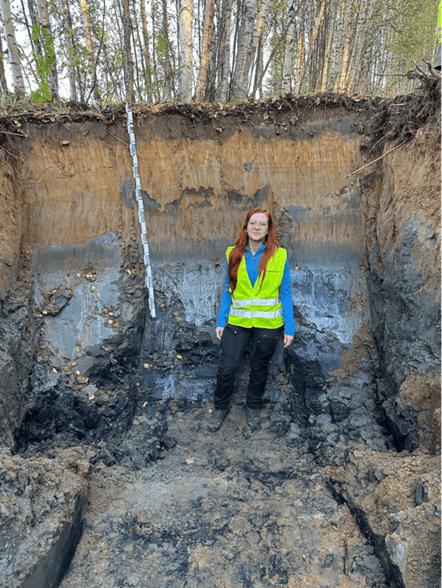
This (photo 4) is an example of typical characteristics for acid sulfate soils in this area, with sand in the surface layer. We got ridiculously excited when the pit was excavated for us there and then. The topic of this site was corrosion risks in structure/infrastructure due to acid sulfate soils, a subject researched in the project SmartASS [6].
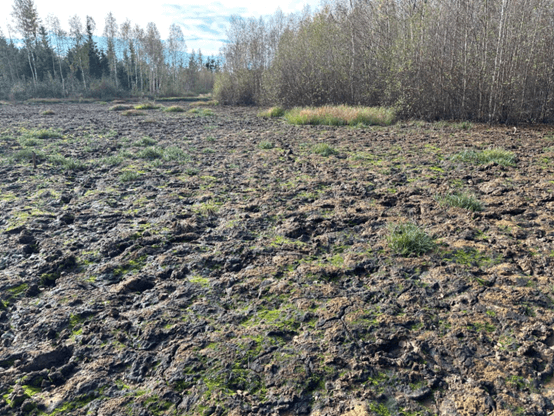
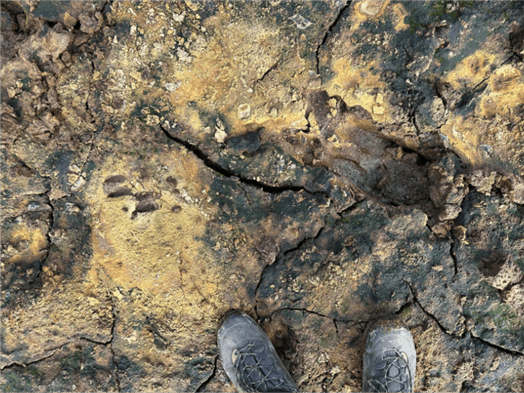
The site that I found to be the most interesting to visit was the sulfuric wetland in Nykarleby (photo 5 and 6). It is particularly interesting because currently, this sulfuric wetland is the only known occurrence in Finland.
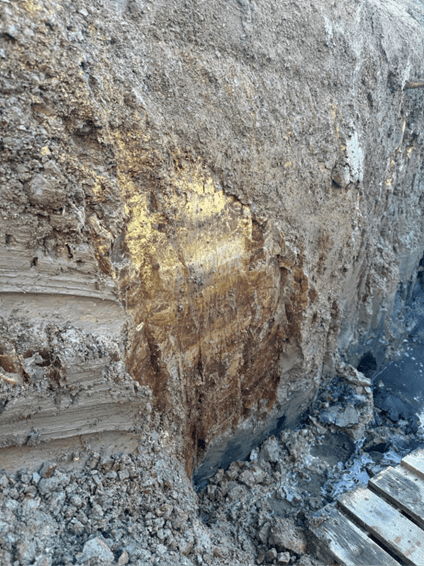
Söderfjärden is perhaps one of the most famous acid sulfate soil areas in Finland. It is an impact crater that now hosts some of the most fertile farmlands in the country. The area is very distinct in satellite images, a hexagonal shape [7], consisting of a puzzle of farmlands. At the site, we got to see great examples (photo 7) of the mineral jarosite (pale yellow) and iron oxyhydroxides (brownish), which are typically associated with acid sulfate soils in Finland [8].
Fun non-geology fact: this place is also known for its abundance of common cranes, as it’s their most popular resting place in Finland. The most recent record is almost 15,000 cranes in 2022! [9]
Final thoughts about the conference
Attending a conference is something I wholeheartedly recommend! And at a smaller conference like this one, it is easy to connect with people, which makes networking and socializing completely different compared to larger conferences. No parallel sessions also means that everyone will listen to each presentation, and you don’t need to decide which session to go to next. After this week-long conference trip, my clothes (and probably myself as well) were muddy and smelled of sulfur. I was in the habit of Swedish “fika” twice a day. I was tired, but first and foremost, I was very happy. I’m feeling excited and eager about my own and others’ research, and about the welcoming and friendly research community!
In addition to the Digital Waters PhD pilot, my PhD work has also been funded by the KIPSI project (Centre for Economic Development, Transport and the Environment) and the K.H. Renlund Foundation.
8.10.2025.
References
- The 10Th International Acid Sulfate Soil Conference
- Ljung, K., Maley, F., Cook, A. & Weinstein, P., 2009. Acid sulfate soils and human health—A Millennium Ecosystem Assessment. Environment International 35, 1234–1242. http://dx.doi.org/10.1016/j.envint.2009.07.002
- Dent, D.L., Pons, L.J., 1995. A world perspective on acid sulphate soils. Geoderma 67, 263–276. https://doi.org/10.1016/0016-7061(95)00013-E.
- Toivonen, J., Boman, A. 2024. Discharge of potentially toxic elements from acid sulfate soils in western Finland: Conflict between water protection and land use?, Regional Studies in Marine Science, Volume 71, 103426, https://doi.org/10.1016/j.rsma.2024.103426
- Tunnistus project report: Visuri M., Nystrand M., Auri J., Österholm P., Nilivaara R., Boman A., Räisänen J., Mattbäck S., Korhonen A. ja Ihme R. 2021. Maastokäyttöisten tunnistusmenetelmien kehittäminen happamille sulfaattimaille. Tunnistus -hankkeen loppuraportti. Suomen ympäristökeskuksen raportteja 43/2021. Helsinki. http://hdl.handle.net/10138/336344
- SmartASS project: https://www.syke.fi/en/projects/utilization-acid-sulfate-soils-smartass
- NASA Earth Observatory – The Many Facets of Söderfjärden: https://earthobservatory.nasa.gov/images/153774/the-many-facets-of-soderfjarden
- Boman, A., Mattbäck, S., Becher, M., Yli-Halla, M., Sohlenius, G., Auri, J., Öhrling, C., Liwata-Kenttälä, P. & Edén, P., 2023. Classification of acid sulfate soils and soil materials in Finland and Sweden: Re-introduction of para-acid sulfate soils. Bulletin of the Geological Society of Finland, this volume. https://doi.org/10.17741/bgsf/95.2.004
- YLE article about cranes in Söderfjärden: https://yle.fi/a/7-10021329