“Best” Bhattarabhop Viriyaroj, Aalto University. bhattarabhop.viriyaroj@aalto.fi
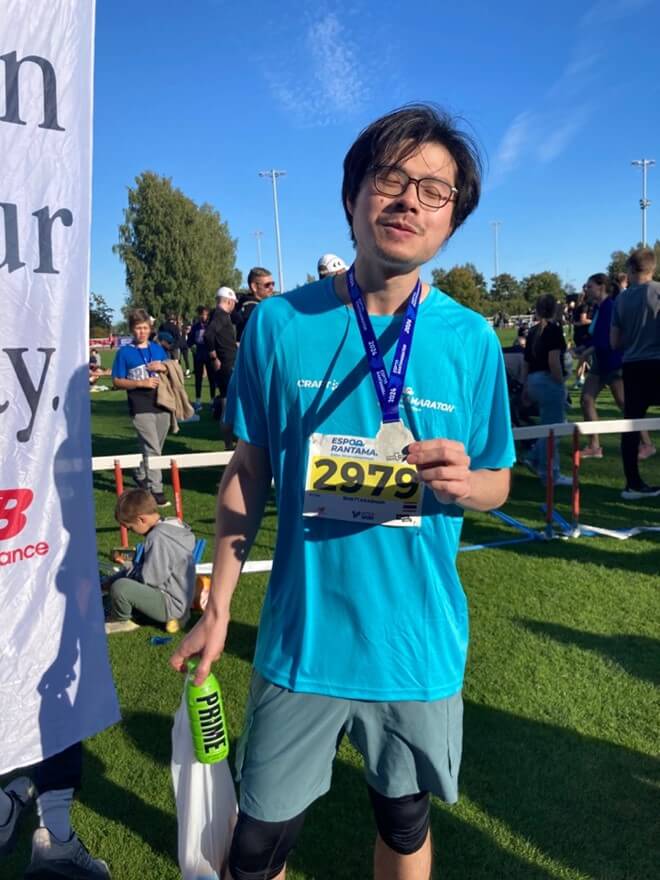
“Doing a doctoral study is a marathon.”
This quote was told to me by one of my colleagues in the research group. Half a year into my PhD, this thought kept circling in my head. After the first six months, I ended up taking a one-month vacation to recover from nearly burning out while not making much progress in my research.
How did this happen? Let’s see the journey I have taken so far. I started my PhD two months after finishing my master’s. I put a lot of effort into writing the thesis, and it paid off with a full grade. However, along with the grade, I also became severely burnt out. During the subsequent two-month recovery period, I was offered the position for the PhD while continuing my research on the same topic. Still recovering, I happily accepted the position and wrote my application.
For those who have written the application before, you would understand the difficulty of coming up with plans for your future research over the next four years. Nevertheless, the plan was finished on time, and the application was sent. However, while writing the plan, I accepted a mentoring position for an intense course, which ran from January until June. Additionally, I was also studying and advising a master’s student on his thesis during the mentoring.
You might be able to see the issue here. I was completing task after task when none of them was about my research. I ended up feeling frustrated and less confident about my capabilities as a researcher after six months. I kept forgetting deadlines and felt less and less motivated as time went on. Thankfully, I had great support from people around me, including other Digital Waters doctoral researchers, my supervisor, and other researchers in the research group. These people supported me and gave me advice and tips on how to do the PhD.
The “marathon” did not start well for me. Luckily, I learned from the people mentioned above how to run this marathon properly. I came to understand the difficulty of balancing work and life, as well as how difficult it is to manage many tasks at once. I realized that my problem was not that I wasn’t working hard enough; the problem was that I was doing too many other things aside from my research. A rule of thumb (recommended by my supervisor) is that approximately 75% of your time should be spent doing your research (or attending courses), 5-10% on teaching, and 15-20% on other things. Now let’s count. I was spending 30% of my time on research and 70% on other things. Basically, I swapped my priorities.


I spent a lot of time networking and collaborating on other research projects aside from my research. These are all the things that are recommended for doctoral researchers to do. However, you can overdo this. Networking and collaborating are important in your research career, but (and this might sound obvious), you need to do your research as well to be a researcher. Moreover, I made a fatal error in expecting myself to finish the first article in a couple of months after starting my study, then ended up self-criticizing harshly when I could not reach it. Doing a PhD is not only about researching, but also about how to actually do research.
To summarize, I have come to realize the following: In order to run, you need to “prioritize your research” so that you are not running without direction. In addition, “practice positive self-talk” and “set realistic goals” are important for you to continue running.
However, the most crucial quote of all might be “reflect and improve yourself from your mistakes” because without that, we would not be able to learn from our mistakes and improve ourselves. I sincerely hope this article will help my fellow or future doctoral students in their study journey.
Additional links
- Advice and tips for new PhD students: https://www.thesavvyscientist.com/tips-for-new-phd-students/
- Short practical tips before you start your PhD: https://medicine-vet-medicine.ed.ac.uk/postgraduate/postgraduate-blog/things-to-know-before-starting-phd
- An extremely useful and comprehensive introduction to research: Crone, Wendy C. “Introduction to engineering research.” Introduction to Engineering Research. Cham: Springer International Publishing, 2020. 1-5. https://doi.org/10.1007/978-3-031-02083-4_1
9.8.2025.