
Webinar

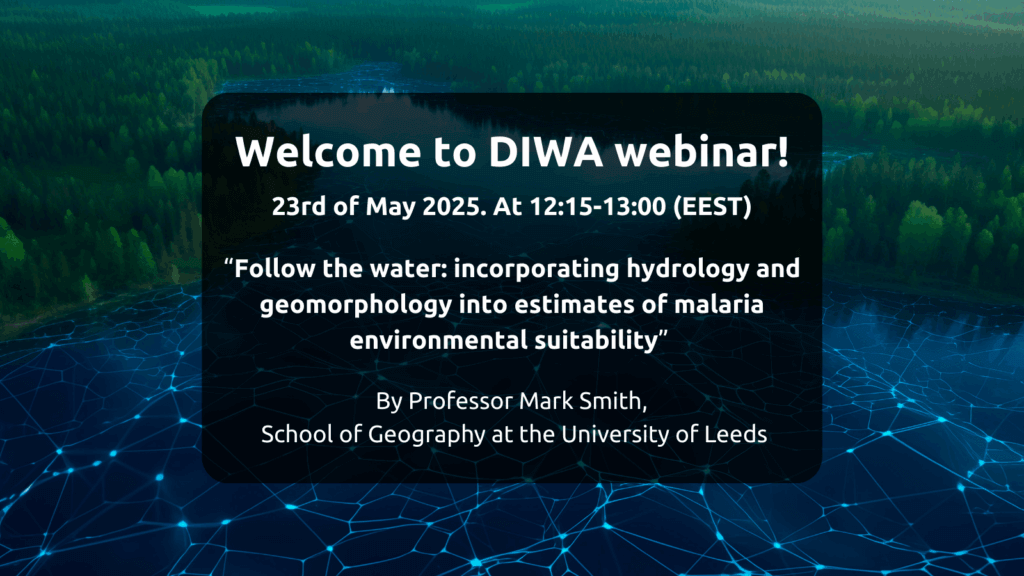
DIWA Webinar: Professor Mark Smith, School of Geography at the University of Leeds

Welcome to the DIWA webinar on the 23rd of May!

This seminar is open to all, and no registration is needed.

Professor Mark Smith from the School of Geography at the University of Leeds is visiting DIWA at the University of Turku. Smith will give a lecture on Friday, the 23rd of May. 

Webinar content:

Who: Professor Mark Smith

What: “Follow the water: incorporating hydrology and geomorphology into estimates of malaria environmental suitability”

Time: From 12:15 to 13:00. 

Where: lecture hall XXI, Agora (At the University of Turku).

Remote link: You can follow the lecture remotely here: https://echo360.org.uk/section/68e6c817-a644-4189-b9f2-3a7b1d66978b/public

Mark Smith is a Professor of Water Science and Health, whose research focuses on geomorphology, hydrology, and public health, with particular emphasis on how water-related processes impact human well-being. His work includes extensive research on how hydro-geomorphological dynamics influence malaria transmission in Africa, as well as the effectiveness of natural flood risk management techniques in rivers and peatland landscapes.
Share the Post:

Related Posts

PhD Pilot blog Amirhossein Nourian

Enhancing Energy Efficiency in Robotic Environmental Monitoring

Amirhossein Nourian, University of Turku, amnour@utu.fi Environmental monitoring is becoming increasingly important in a world facing rapid climate change, biodiversity loss, and environmental risks. Autonomous robots are emerging as powerful tools for monitoring ecosystems, as they can operate in remote, hazardous, and hard-to-reach environments. However, one of the most critical

PhD Pilot blog Sajjad Mohammadzadeh Vatanchi

Smarter Short-Term Hydropower Regulation: Coupling Hydrology and Energy Modeling with AI Forecasting

Sajjad Mohammadzadeh Vatanchi, University of Oulu, Sajjad.MohammadzadehVatanchi@oulu.fi Short-term hydropower regulation is at the heart of balancing renewable energy supply and demand in today’s dynamic power systems. But with increasing climate variability and pressure for clean energy, traditional methods are no longer enough. My research examines how coupling hydrological and energy