
Elina Heikkilä, University of Eastern Finland, elina.heikkila@uef.fi
The source-to-sea approach is a core concept of Digital Waters research. In DIWA, water systems are studied as an integrated whole that connects the atmosphere, soil, groundwater, surface waters, and the marine environment. While this holistic perspective is adopted in environmental sciences, it is less clearly reflected in legal research. Indeed, legal instruments governing water and marine environments are still largely divided between freshwater and ocean frameworks.
In this blog post, I introduce a recent collaborative article that examines the source-to-sea approach from a legal perspective by asking to what extent international and EU freshwater and marine legal instruments adopt source-to-sea thinking, and what legal and governance implications follow from this approach. The article was led by César Soares de Oliveira, who acted as the lead author and guided the writing process in a structured and collegial way. The full author team consists of César Soares de Oliveira, Antti Iho, Elina Heikkilä, Jonas Kyrönviita, Niko Soininen, and Antti Belinskij. All authors were members of the Water and Marine Environmental Law Group at the University of Eastern Finland at the time of writing.
The source-to-sea approach and the problem of legal fragmentation
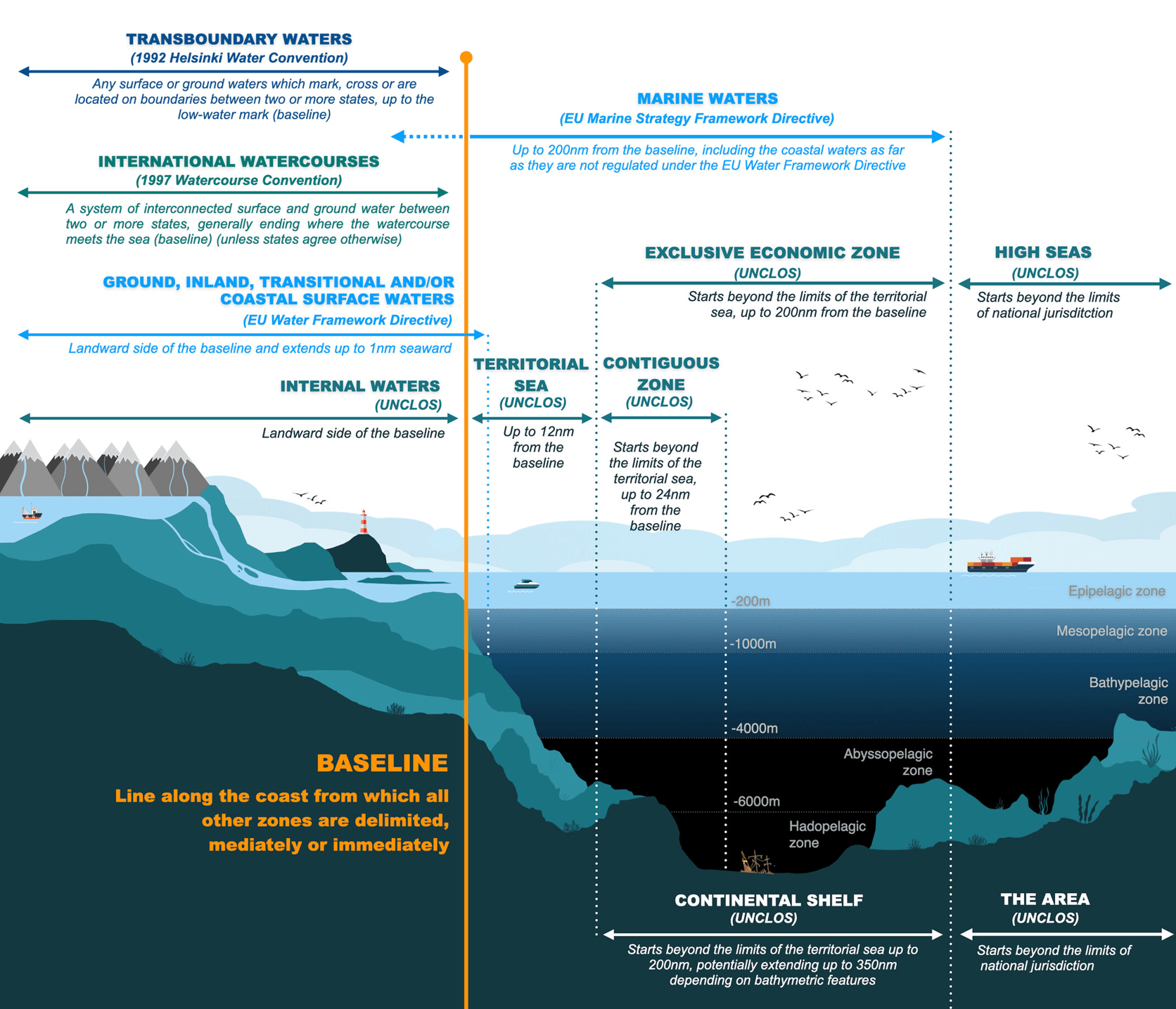
The source-to-sea approach highlights that freshwater systems, coastal zones, and marine areas form one connected ecological continuum. Nutrients, pollutants, sediments, and species move across this system from upstream sources to the oceans. In law, however, this continuum is governed through separate and partly overlapping regulatory frameworks at national, regional, and international levels. Each legal framework has its own concepts, objectives, and geographical scope. As a result, the same water body may fall under different legal regimes and obligations.
The figure makes visible a central challenge for source-to-sea governance. While ecological systems connect land and sea, legal systems tend to divide them. This makes it difficult to address issues such as land-based pollution or the decline of migratory species along the entire source-to-sea continuum.
Why integrated water systems need integrated law
One of the main conclusions of the article is that an integrated and holistic approach is also needed in legal regulation if the source-to-sea perspective is to be taken seriously. Current legal frameworks contain useful tools, but they are fragmented and sometimes inconsistent. In our analysis, we show that the structural and conceptual fragmentation between water and ocean law causes regulatory incoherence. For example, EU law offers some promising connections between freshwater and marine regulation, particularly through the interaction between the Water Framework Directive and the Marine Strategy Framework Directive. Still, important differences remain in how binding their objectives are, which can even create incentives to shift environmentally harmful activities from freshwater or coastal areas further offshore.
From a DIWA perspective, legal research can play an important role in making source-to-sea thinking operational beyond the natural sciences. If we want to manage water systems as connected social and ecological systems, legal frameworks need to better reflect that same continuity.
Further reading
The full article is open access and available here:
https://onlinelibrary.wiley.com/doi/10.1111/reel.70031.
28.4.2026