Authors: Pertti Ala-Aho, Noora Veijalainen, Anna Kontu & Harri Koivusalo
Edited by: Hanna Holappa
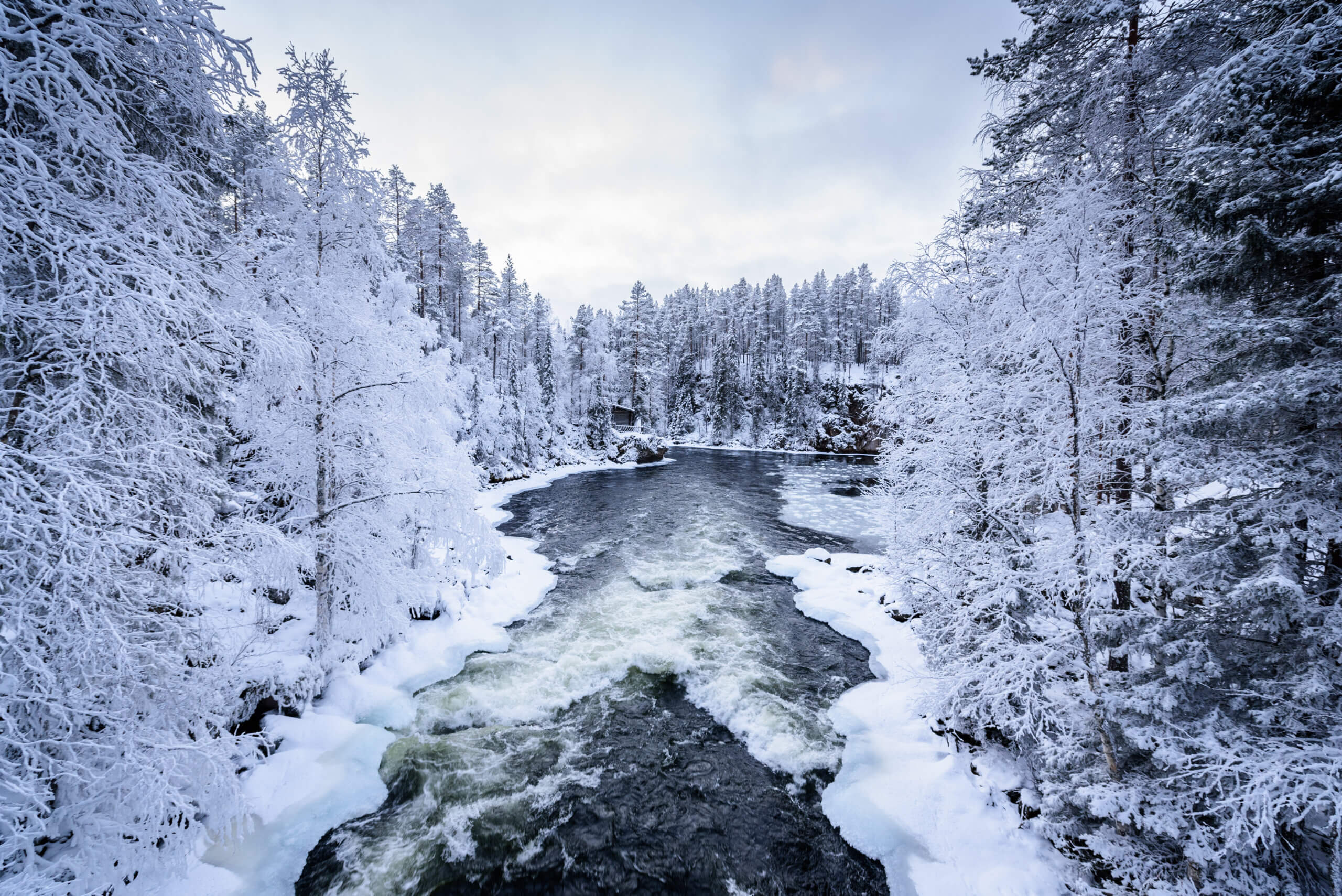
Floods and melting snow in wintertime, extreme rain events, and dry and hot summers. Some of the unusual weather we have experienced can be attributed to ongoing climate change, which causes rising temperatures, changing rainfall patterns, and, in most of Finland, a decrease in snow cover. These turn affects water quantity and quality in rivers and lakes, as well as ecosystems and society.
In Finland, climate change is especially evident in the seasonal variation of river flows and lake water levels. These shifts are no longer just projections for the future; they can already be seen in long-term observational data. Seasonal snow cover and spring snowmelt have traditionally been defining features of Finland’s hydrological regime, but climate change is altering this seasonal rhythm. Understanding these changes is essential for managing water resources sustainably.
Studying climate impacts on water
The Digital Waters Flagship focuses on assessing how climate change affects runoff, snow conditions, river discharges, soil moisture, water quality, and aquatic ecosystems. Reliable impact assessments require combining the latest climate science with advanced hydrological and impact models. For this purpose, DIWA uses the newest climate model scenarios from the IPCC’s 6th Assessment Report, known as CMIP6 scenarios. These are based on updated global climate models and different socio-economic pathways describing future greenhouse gas emissions. Compared to earlier model generations, CMIP6 climate models show improvements in key aspects such as the persistence and frequency of large-scale atmospheric circulation patterns. These improvements help produce more realistic simulations of future climate conditions, which are then used as inputs for national-scale and catchment-scale hydrological models.
National scale hydrological scenarios calculated with the Finnish Environment Institute’s WSFS-P hydrological model using these latest climate scenarios show an average small increase (about 6 %) in average runoff from the reference period 1991-2020 to the 2040-2069 period. However, the most significant changes are seasonal rather than annual. Winter runoff is projected to increase, while summer runoff is expected to decrease. Snow amounts are likely to continue declining in southern and central Finland, whereas changes in northern Finland are smaller by mid-century. Despite these general trends, uncertainty remains high. Different climate models produce a wide range of outcomes, from slight decreases to substantial increases in average runoff. This uncertainty grows even larger toward the end of the century, as greenhouse gas concentration pathways diverge further.
Modelling across scales
Climate change affects the hydrological cycle across scales – from the water inflow to a single stormwater pumping station for ecosystem water use at the continental scale. To capture this complexity, the Modelers in DIWA are working with multiple simulation tools that allow them to zoom in and out, depending on the research and management question. The model applications address the processes across the main land use types from forested and agricultural areas to urban blocks.
Controlled drainage, irrigation, and nature-based water management measures are examined as potential solutions to ensure water availability and mitigate adverse impacts. In urban areas, stormwater modeling addresses precipitation of extremes and strategies for their management and preparedness. Long-term modeling focuses on the combined effects of changing climate drivers and land-use dynamics.
Hidden changes in snow conditions
Changes in snow cover are among the most well-documented impacts of climate change in Finland, with clear long-term trends showing declining snow-covered areas. However, more subtle changes—such as mid-winter thaws and rain-on-snow events—are often overlooked.
As part of DIWA’s modeling work, detailed process-based snow models are used to analyze both past and future changes in snowpack structure. This allows researchers to examine how characteristics such as snowpack density and snow layer structure have evolved and are likely to change across Finland. Information on features like hard ice layers within the snowpack can be crucial for practical activities such as reindeer herding and forestry operations, even though these details are easily missed if attention is limited to snow depth or duration alone.
This research on climate change impacts on snow and water resources is essential for supporting adaptation to climate change and continuing to keep Finland’s preparedness to water risks at a high level, also in the future. These results demonstrate clear societal relevance: national-scale climate and hydrological scenarios produced by the Finnish Environment Institute (Syke) will be used as input for guidance to local authorities on how to account for climate change impacts when implementing the EU Water Framework Directive and Floods Directive. In this way, the research directly supports improved water resources and flood risk management under changing climatic conditions.
19.1.2026.