
Authors: Simo Sarkki , Mia Pihlajamäki, Mirjami Lantto Klein, Christoph Gocht, Marko Keskinen and Alexandra Malmström.
Edited by: Hanna Holappa
Water is the essence of life, but how can it be managed to reach desirable futures for people and the environment? Digital Waters (DIWA) has a unique position not only to enhance our understanding of water as a complex flux, but also to enable and use agency to make the transformations happen in the real world.
Research carried out in DIWA Research Theme (RT) 5 focuses on “Transformative Water Management” and explores the linkages between water sector digitalization and water management and governance.
RT5 complements other DIWA research themes focusing on hydrology processes (RT1), new observational systems (RT2), integrated analysis and modelling (RT3), and digital services and platforms (RT4) in two parallel ways: by linking the novel digital solutions with on-going planning and management processes, and by co-producing systemic understanding on human-water interconnections and their broader governance including role of DIWA researchers as catalysts for sustainable water futures. The additional focus on water governance seeks to enhance our understanding of how decisions about water are made and implemented, who has agency, and what the related trade-offs and justice issues are for societies, people, other species, and ecosystems.
Water management and governance
Water management is the practice of planning, developing, and managing water resources for various uses, while also addressing water-related risks like floods and droughts. Water management is thus about practical actions that affect water. While DIWA RT5 focuses on water management, we also consider broader water governance processes, as these are needed to understand the underlying foundations and structures for water management.
Water governance can be defined as institutions, decision-making structures and processes, and actors who make decisions linked to water and implement them. Human actors come from different societal domains of state, business, civil society, and science, and interact in various decision forums. These forums can take many forms, including governmental decision-making processes, EU-level policy initiatives, impact assessment procedures, Grassroots social movements, and scientific advisory bodies that support evidence-based policymaking. Water governance is never limited to water alone; it is situated within the broader context of societal activities, including agriculture, forestry, and land-use planning. It is also a vital part of current societal efforts to reduce greenhouse gas emissions, adapt to a changing climate, and preserve or restore biodiversity. In DIWA’s RT5, we analyze what sustainable water governance means in these processes and what kind of role increasing digitalization plays in them.
Transformative water management
The term “transformative” has three distinct but interlinked meanings in DIWA and its RT5 on transformative water management. First, we note the critical need for transformative change towards sustainability to address the underlying causes of climate change, biodiversity loss, and social inequalities. Such a transformative change is by no means easy, but requires –in the words of IPBES (2019)– a fundamental, system-wide reorganization across technological, economic, and social factors, including paradigms, goals, and values. and involving shifts in views, structures, and practices.
Second, we note that digitalization is transforming the ways we measure, observe, and analyze water resources. Real-time monitoring and analytics, and the related development of Digital Twins, will, together with the rapid emergence of artificial intelligence, fundamentally change several key aspects related to water-related analysis, planning, and management. At best, this digital transformation can be used to facilitate sustainability transformation, e.g., by the European Commission in its conceptualization of “twin green and digital transition”.
Third, and following from the two transformations above, we also need to transform water management and governance itself. Our current management practices and governance structures are ill-prepared to respond to the demands that the twin transformation above requires. Furthermore, we focus on the opportunities that digitalization provides to steer more sustainable water governance and management processes by exploring how digitalization, including Digital Twins, can enhance collaborative governance processes and support participatory decision-making for sustainability. We also critically explore potential drawbacks that digital representation of social-ecological-technological systems may entail, what that would mean for governing and managing water sustainably, and how we could avoid negative consequences.
Finally, RT5 emphasizes that we as researchers are also part of the transformations. In Science and Technology Studies (STS), it has been emphasized that often, if not always, changes in society affect science and vice versa. In other words, science and society are in a coevolutionary relationship. This places responsibility for DIWA to seek to enhance commonly agreed desired futures, by producing a systemic understanding of water-related issues, and by doing and catalyzing changes and agency that can enable transformations towards desired futures. We need not only to understand water management and governance, but also our own roles in shaping it.
DIWA’s ongoing research on these themes
In May 2025, DIWA RT5 had a hybrid meeting where transformative water management and governance were discussed through a set of presentations by DIWA PhD researchers and post-docs. The key insights from presentations in the DIWA RT 5 meeting are synthesized in Figure 1 on transformative water governance and the ways by which RT 5 researchers approach it.
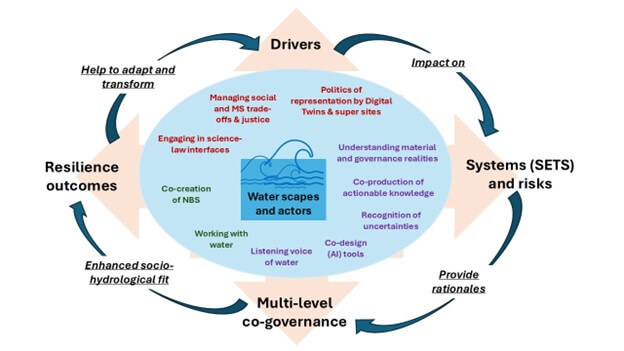
The visualization of Figure 1 was done by Simo Sarkki based on the discussions in our RT5 meeting in May 2025. The acronym “NBS” stands for nature-based solutions, “AI” stands for artificial intelligence, and MS stands for multispecies (including people).
- The dark blue box in the middle of the figure represents waterscapes and (other) governance actors from the domains of state, business, civil society, and science.
- The light blue circle represents the ways in which DIWA RT 5 researchers engage in transformative water management and governance. These ways are divided into three clusters.
- The red cluster links to ways of understanding and shaping power relations around water.
- The purple cluster considers ways in which knowledge co-production is practiced.
- The green cluster connects to ways in which RT 5 researchers work with water as a material agent.
- The outer circle presents an applied view on the policy cycle, where a set of drivers (e.g., climate change, policy, demography, economy, innovation) impact Socio-Ecological-Technological Systems, involving the creation of risks. The conditions and changes in these systems provide rationales for re-arranging multilevel collaborative governance, which seeks to enhance fit between human decision-making systems and water. Socio-hydrological fit refers to matching decision-making systems and characteristics of water. Such a fit can enhance bounce-forward resilience of the Socio-Ecological-Technological systems, implying positive adaptation and transformative change, which can then change the drivers, starting a new cycle.
Driving transformation through cooperation
DIWA is a huge undertaking, including dozens of researchers and experts working in various fields. As such, it has unique potential to advance transformation in the water field – in all three meanings of transformations and their linkages (sustainability transformation, digital transformation, and water management transformation).
This is not, however, an easy task and requires active cooperation both within the DIWA as well as with DIWA’s partners – in other words, well-facilitated in inter- and transdisciplinary knowledge co-production. We are working on such co-production processes, and welcome everyone interested on board!
3.11.2025.