
Pietari Pöykkö, University of Oulu. pietari.poykko@oulu.fi
When we think of water, pictures of lakes, rivers, or rain may come to mind. However, beneath the feet lies a much larger reservoir: groundwater. Stored in soil and rock layers, groundwater supports ecosystems, supplies drinking water, and helps regulate the flow of surface water. The level of groundwater rises and falls according to the weather conditions – heat, wind, and vegetation growth cause groundwater to evaporate, while rainfall and snowmelt recharge it. More importantly, its seasonal rhythm has changed over the last decades.
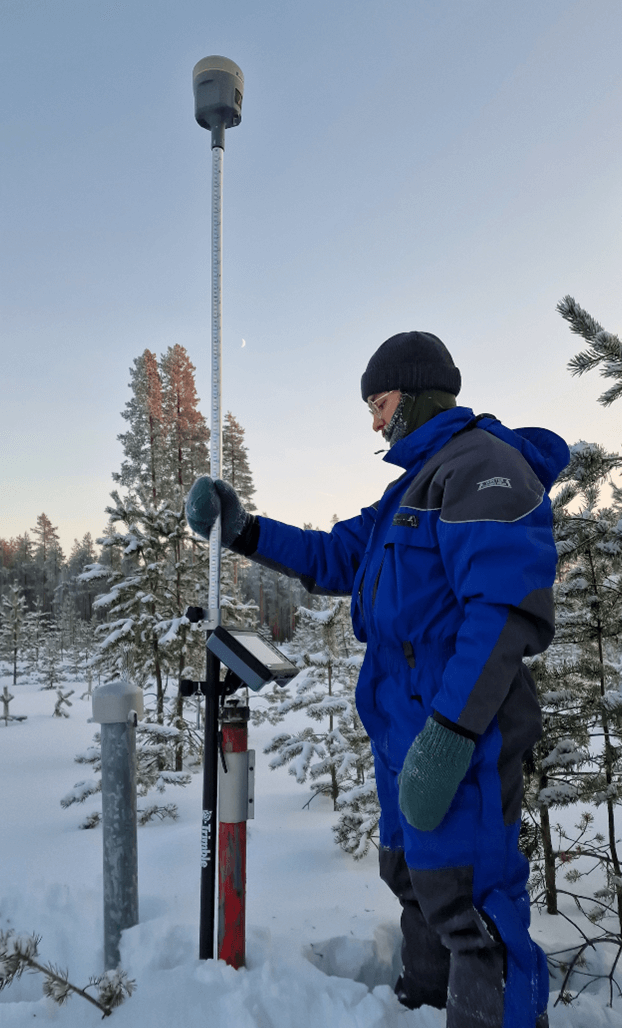
water monitoring pipes. Picture: Olli Häkkinen.
In Finland – on the transition to the boreal climate zone, and home to long winters and short summers, groundwater plays an important role. In addition to its role in ecosystem functioning, it is a vital source of water for agriculture, industry, cities, and settlements. The seasons in the north are hydrologically very distinct due to the cold winters. Snow covers the ground for months, and the soil may freeze deeply. This freeze-thaw cycle has a big impact on groundwater. In winter, precipitated snow accumulates above ground, and frozen soil can prevent or slow down the groundwater recharge from possible rainfall.
When spring arrives and the accumulated snow melts, the groundwater levels rise quickly. This creates a predictable annual pattern, like a heartbeat beneath the forest floor: low levels in winter, a sharp rise in spring, and a gradual decline through summer and autumn. The pattern is variable throughout the country, mostly depending on temperature, which dictates the timing of spring melt and the onset of winter.
Efforts to monitor groundwater in Finland nationwide began in the 1970s. The goal of the established monitoring network was to inform citizens about the current situation, improve the knowledge of groundwater, produce data to assess changes in groundwater, and aid in decision-making related to water use. The network is managed by the Finnish Environment Institute and ELY-centers. In the present day, the work done by dozens of citizen observers over many decades has come to fruition: we can now see notable changes in groundwater conditions.
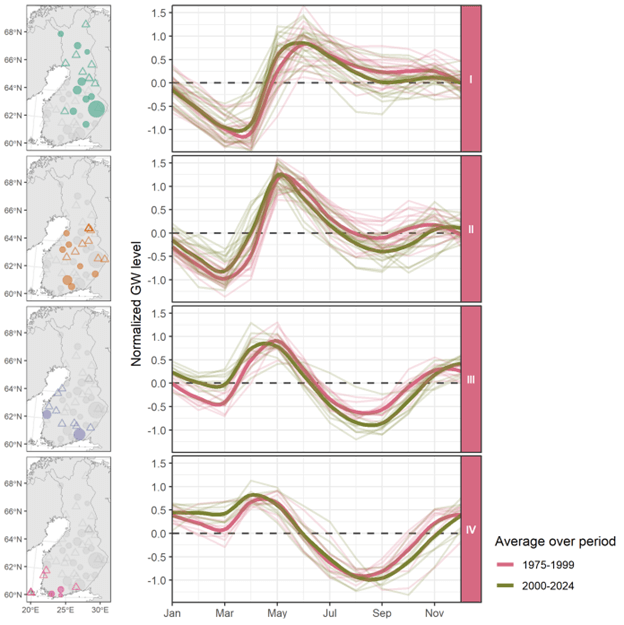
How the Annual Groundwater Pattern Is Changing
- Earlier Snowmelt: Warmer springs are causing snow to melt earlier. This means groundwater recharge starts sooner, but may also be less intense if snowpacks are smaller, or the ground frost layer is weaker.
- Drier Summers: Vegetation and growth season changes will increase evapotranspiration, leading to lower groundwater during summer and autumn, and possibly lower extremes.[1]
- Increased Rainfall: Some boreal regions are seeing more rain, especially in autumn. This can lead to increased variability in groundwater levels later in the year, and the levels may rise more towards winter.
- Thawing Permafrost: In areas with permafrost, warming temperatures are causing it to thaw. This changes how water moves through the soil and can lead to more variable groundwater levels, in addition to numerous other effects. There is no permafrost in Finland, but substantial regions of the northern hemisphere are affected.[2]
Changing groundwater patterns affect everything from forest health to water quality. Trees may struggle to access water during dry spells, wetlands might shrink, and streams could run lower in summer, or they could have higher peaks during storms. For communities that rely on groundwater for farming or as a water supply, these shifts can be especially important.
Looking Ahead
Understanding groundwater in the boreal zone is important for humans and the environment. As climate patterns continue to evolve, continuing to track these hidden changes helps us protect ecosystems and plan and prepare our water use for the future. There is still a lot to learn from the vast amount of collected groundwater monitoring data, and the monitoring efforts should continue strongly, for all our sakes. Groundwater may be out of sight, but it’s never out of impact.
Connect & More
If you want to know more about the topic or connect, you can reach me via the email above or on LinkedIn.
References
- [1] Laîné, A., Nakamura, H., Nishii, K., Miyasaka, T., 2014. A diagnostic study of future evaporation changes projected in CMIP5 climate models. Clim Dyn 42, 2745–2761. https://doi.org/10.1007/s00382-014-2087-7
- [2] Bring, A., Fedorova, I., Dibike, Y., Hinzman, L., Mård, J., Mernild, S.H., Prowse, T., Semenova, O., Stuefer, S.L., Woo, M.-K., 2016. Arctic terrestrial hydrology: A synthesis of processes, regional effects, and research challenges. Journal of Geophysical Research: Biogeosciences 121, 621–649. https://doi.org/10.1002/2015JG003131
28.8.2025.