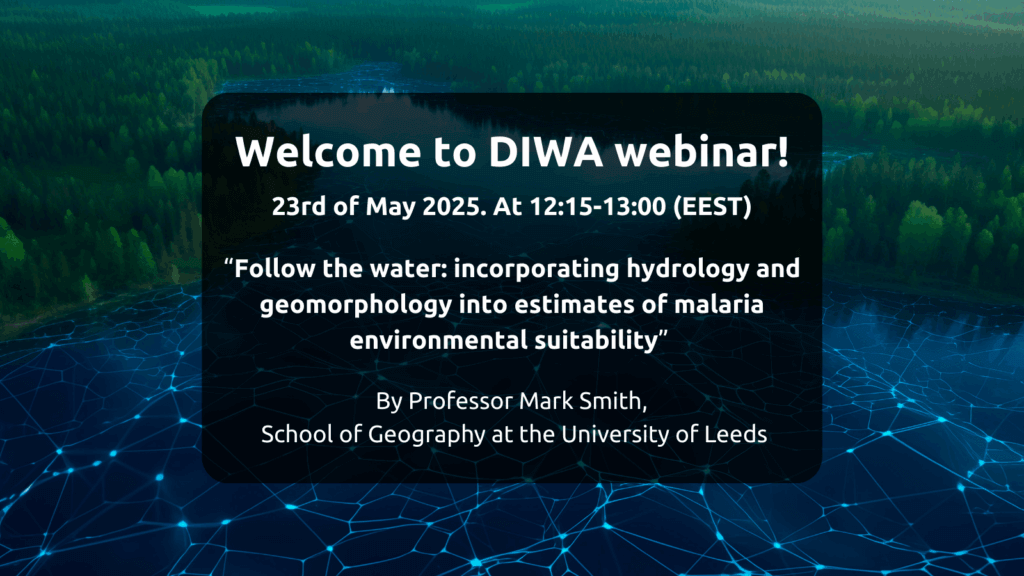
Welcome to the DIWA webinar on the 23rd of May!
This seminar is open to all, and no registration is needed.
Professor Mark Smith from the School of Geography at the University of Leeds is visiting DIWA at the University of Turku. Smith will give a lecture on Friday, the 23rd of May.
Webinar content:
Who: Professor Mark Smith
What: “Follow the water: incorporating hydrology and geomorphology into estimates of malaria environmental suitability”
Time: From 12:15 to 13:00.
Where: lecture hall XXI, Agora (At the University of Turku).
Remote link: You can follow the lecture remotely here: https://echo360.org.uk/section/68e6c817-a644-4189-b9f2-3a7b1d66978b/public
Mark Smith is a Professor of Water Science and Health, whose research focuses on geomorphology, hydrology, and public health, with particular emphasis on how water-related processes impact human well-being. His work includes extensive research on how hydro-geomorphological dynamics influence malaria transmission in Africa, as well as the effectiveness of natural flood risk management techniques in rivers and peatland landscapes.